Blog

  • Dr. Sabina Dongol Selected for ISARIC Leadership Programme for Scientists 

    Dr. Sabina Dongol Selected for ISARIC Leadership Programme for Scientists 

    Launched by ISARIC in collaboration with Universidad de La Sabana, Colombia, and INALDE Business School, Colombia, the programme is designed to equip emerging scientists with the skills and support needed to lead impactful research and drive positive change within their institutions and communities. 

    About Dr. Sabina Dongol 

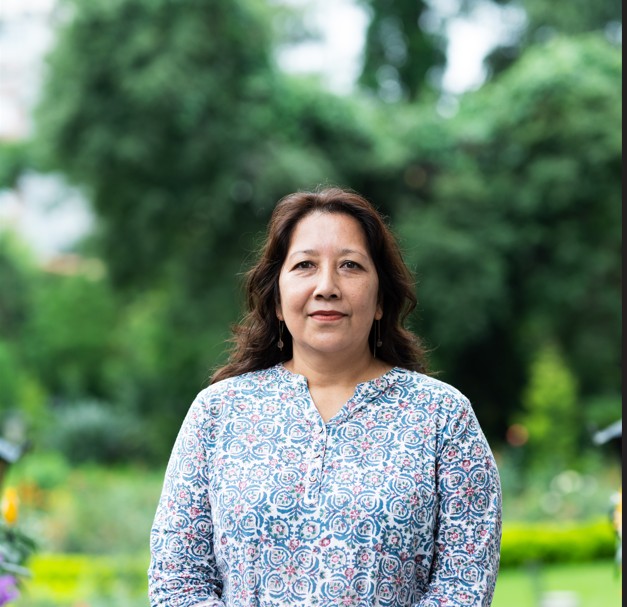
    Dr. Dongol is the head of OUCRU Nepal laboratories and is a highly accomplished researcher with a DPhil from the University of Oxford and has extensive expertise in medical microbiology and laboratory management. Her research focuses on enteric fever, and in particular, looking at improving diagnostics for acute febrile illnesses — an area critical to enhancing public health outcomes. 

    Her leadership and technical knowledge are instrumental in the success of clinical trials and research projects at OUCRU-Nepal. She is also an active member of the American Society of Tropical Medicine and Hygiene (ASTMH), engaging in global collaboration and scientific exchange. 

    Read more ISARIC Leadership Programme     

  • World Mental Health Day 2025: Ensure mental health access for all during times of crisis

    World Mental Health Day 2025: Ensure mental health access for all during times of crisis

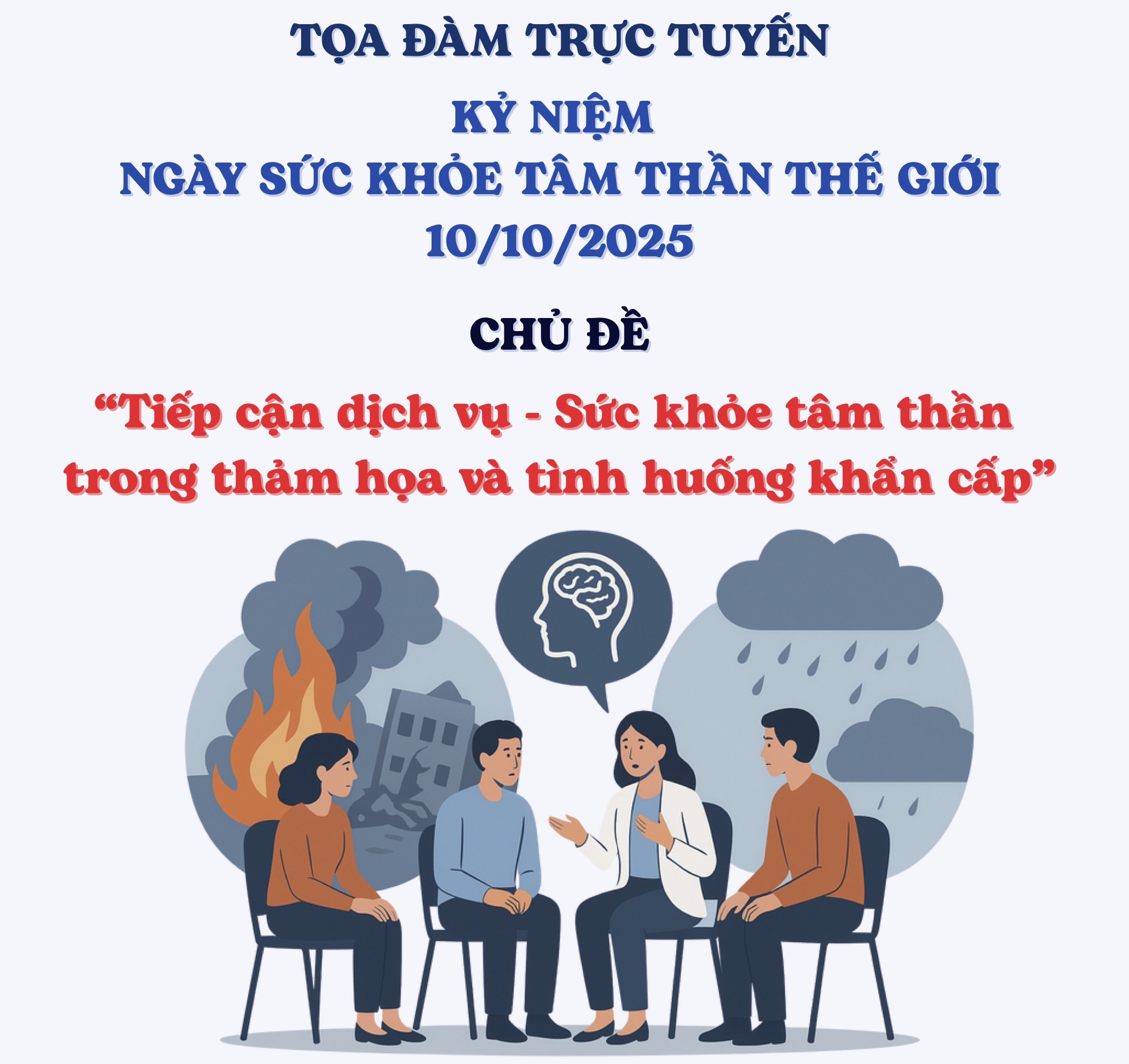
    10 October is chosen to be World Mental Health Day. This year theme focuses on “Mental health in humanitarian emergencies”, highlights the essential need to support mental health during crises like natural disasters, and public health emergencies.

    According to WHO, around 1 in 5 people in conflicted-affected areas are estimated to have a mental health condition. Experiencing fear, anxiety or sadness in such circumstances is a normal reaction to very stressful events. Beyond food, water, and medicine, survivors also need mental health and psychosocial support to cope, recover, and rebuild. Making mental health and psychosocial support a core part of emergency response not only saves lives but also strengthens communities and health systems for the future.

    Among people who are in need of mental health support during disasters and emergencies, field workers often face extreme stress due to the direct effect they respond to, heavy urgent workload in difficult working environment. To support field workers, in partnership with Medisetter, OUCRU’s Public and Community Engagement Group organised a webinar focusing on helping field workers equip with psychological first aid for not just themselves but people around them. You can watch the webinar’s recording here.

    Coincidentally, Vietnamese Psychotherapy Association organises another webinar focusing on Access to Service: Mental Health in Catastrophes and Emergencies on 2025’s World Mental Health Day. You can register here.

    Investing in mental health and psychosocial support helps families, communities, and economies recover from crises, build long-term resilience, and shape stronger health systems. Therefore, mental health care and access should be a priority in multi-level health strategies to ensure it is valued, protected, and accessible for all, especially during times of crisis.

  • OUCRU Nepal’s contribution: Typhoid Still Threatens Millions Despite New Vaccines

    Typhoid fever remains a significant global health challenge despite being entirely preventable. Each year, it is responsible for over 100,000 deaths worldwide, with the highest burden concentrated in low- and middle-income countries where access to clean water, sanitation, and hygiene infrastructure is limited. While effective vaccines, particularly typhoid conjugate vaccines (TCVs), are now available and recommended for use in high-burden areas, the continued transmission of the typhoid fever underscores the urgent need for comprehensive public health interventions. These include expanding vaccination coverage, improving water and sanitation systems, and strengthening disease surveillance to move toward the elimination of enteric fever.  

    What the Study Highlighted 

    The Seminar, led by experts from the UK, Pakistan, India, and Nepal, estimates that over 9 million people were infected in 2021. South Asia alone accounts for 60% of the global cases. Typhoid usually starts with a gradual fever, headache, and fatigue. In children, symptoms can include high fever, vomiting, and stomach pain. If not treated, the disease can lead to serious complications like intestinal perforation and encephalopathy.    

    The Antibiotic Crisis    

    Doctors once relied on antibiotics like ciprofloxacin (a fluoroquinolone family) to treat typhoid. However, in South Asia there is widespread resistance to fluoroquinolones. In parts of Pakistan, scientists have identified “super strains” that resist nearly all common antibiotics, known as extensively drug-resistant (XDR) typhoid. Some patients now need last-resort antibiotics like meropenem, which are very expensive and often beyond the reach of poor patients   

    Vaccines Offer Hope — But Not a Complete Solution    

    New typhoid conjugate vaccines (TCVs) have shown up to 83% effectiveness for at least 5 years after a single dose. Countries like Nepal, Pakistan, Kenya, and Malawi have included TCVs in their national vaccination programs, protecting millions of children. However, there is still no vaccine for paratyphoid fever, a related illness caused by a different strain of Salmonella.    

    Why Prevention Still Matters    

    While vaccines are a strong tool, experts emphasize that access to clean water and sanitation is crucial to eliminating typhoid.  Until every community has safe drinking water and proper waste management, typhoid will keep returning.  

    A Disease We Can Eliminate    

    Since humans are the only known reservoir of the bacteria, scientists believe that eliminating typhoid is achievable. However, this will require a global effort combining public health infrastructure, sanitation improvements, and widespread vaccination.  

    “Studies conducted at OUCRU Nepal have played a pivotal role in shaping both prevention and treatment guidelines for enteric fever. Research published by the team contributed to changes in global prevention strategies and informed treatment protocol. Building on this body of work, OUCRU Nepal made a significant contribution to the recent Lancet Seminar on enteric fever.” said Dr Buddha Basnyat, Chairman of OUCRU Nepal, one of the leading organizations in typhoid research.  

    “As part of ongoing efforts toward the eventual elimination of typhoid, we are now focusing on identifying and treating chronic carriers—individuals who continue to harbor the bacteria in their gall bladders even after recovery,” added Dr. Abhilasha Karkey, Director of OUCRU Nepal. “These carriers act as a hidden reservoir for transmission within communities. Screening and management of such carriers, alongside vaccination and improved sanitation, represent the next crucial step toward interrupting the cycle of infection.  
      

  • OUCRU contributes to defining the first core outcome measurement set for Dengue

    OUCRU contributes to defining the first core outcome measurement set for Dengue

    With more than 14 million dengue cases reported worldwide in 2024 alone, the mosquito-borne viral infection remains a major global health concern. Dengue often causes flu-like symptoms such as high fever, severe headache, pain behind the eyes, muscle and joint pain, nausea, and rash. Although the overall death rate is low, patients with severe dengue are at a much higher risk of dying.

    Even with growing research interest, dengue clinical trials have used many different outcomes and measurement methods. This lack of consistency makes it hard to compare and combine data across studies – something that’s essential for improving guidelines and therefore patient care and outcomes. To address this issue, the researchers developed a Core Outcome Set (COS) and subsequently a Core Outcome Measurement Set (COMS) that can be used in dengue clinical trials worldwide.

    A COS is an agreed-upon, standardised selection of outcomes that should be measured and reported in all clinical trials for a specific condition. A COMS recommends how these outcomes should be measured.

    The COMS was developed in two phases:

    Phase 1 – Development of the DEN-CORE COS

    • Outcome identification: Researchers reviewed existing studies to find all outcomes reported in dengue infection research.
    • Outcome voting and rating: Through an online Delphi process, participants rated which outcomes were most important for hospitalised patients. These participants were various stakeholders, including healthcare workers, and people with lived experience of dengue.

    Phase 2 – Development of the DEN-CORE COMS

    • Instrument identification: Measurement tools identified in the literature were mapped to the key outcomes from Phase 1, with additional suggestions from experts.
    • Instrument review and voting: A separate group of experts reviewed these tools, discussed them in a consensus workshop, and voted on which should be recommended.

    The DEN-CORE COMS defines which outcomes should be measured in all dengue trials but gives researchers flexibility in how they apply them. Which outcomes are used as main (primary) or secondary goals will depend on the type of treatment being tested, the phase of the trial, and its overall objectives.

    Daniel Munblit, Co-Lead of the DEN-CORE Project, Reader in Paediatrics at King’s College London and ISARIC Member Representative for Sechenov University, said “With dengue spreading rapidly across continents, we urgently need new treatments. This global standard provides the clarity regulators and researchers require to evaluate therapies faster and make them more widely accessible.”

    Sophie Yacoub, Co-Lead of the DEN-CORE Project, Associate professor, University of Oxford said that “Bringing together a global consensus on clinically relevant outcomes to be measured in all future dengue clinical trials, is a major step forward for the dengue therapeutics field.”

    Laura Merson, Head of Data, ISARIC, said “Harmonising outcomes across dengue trials strengthens both the quality of each study and the scientific value of the data generated. Initiatives like this support the World Health Organization’s efforts to advance clinical trials globally, ensuring robust evidence for health interventions.”

    The authors note that while participants came from 36 countries, most were from Latin America and Southeast Asia, with fewer from Africa and parts of the Western Pacific. This may affect how well the results apply to all regions.

    Read the full paper on The Lancet Infectious Diseases.

  • Vinh danh các tân Tiến sÄ© cá»§a OUCRU và chào đón các học giả tương lai

    Vinh danh các tân Tiến sĩ của OUCRU và chào đón các học giả tương lai

    Xin chúc mừng các tân tiến sĩ của OUCRU!

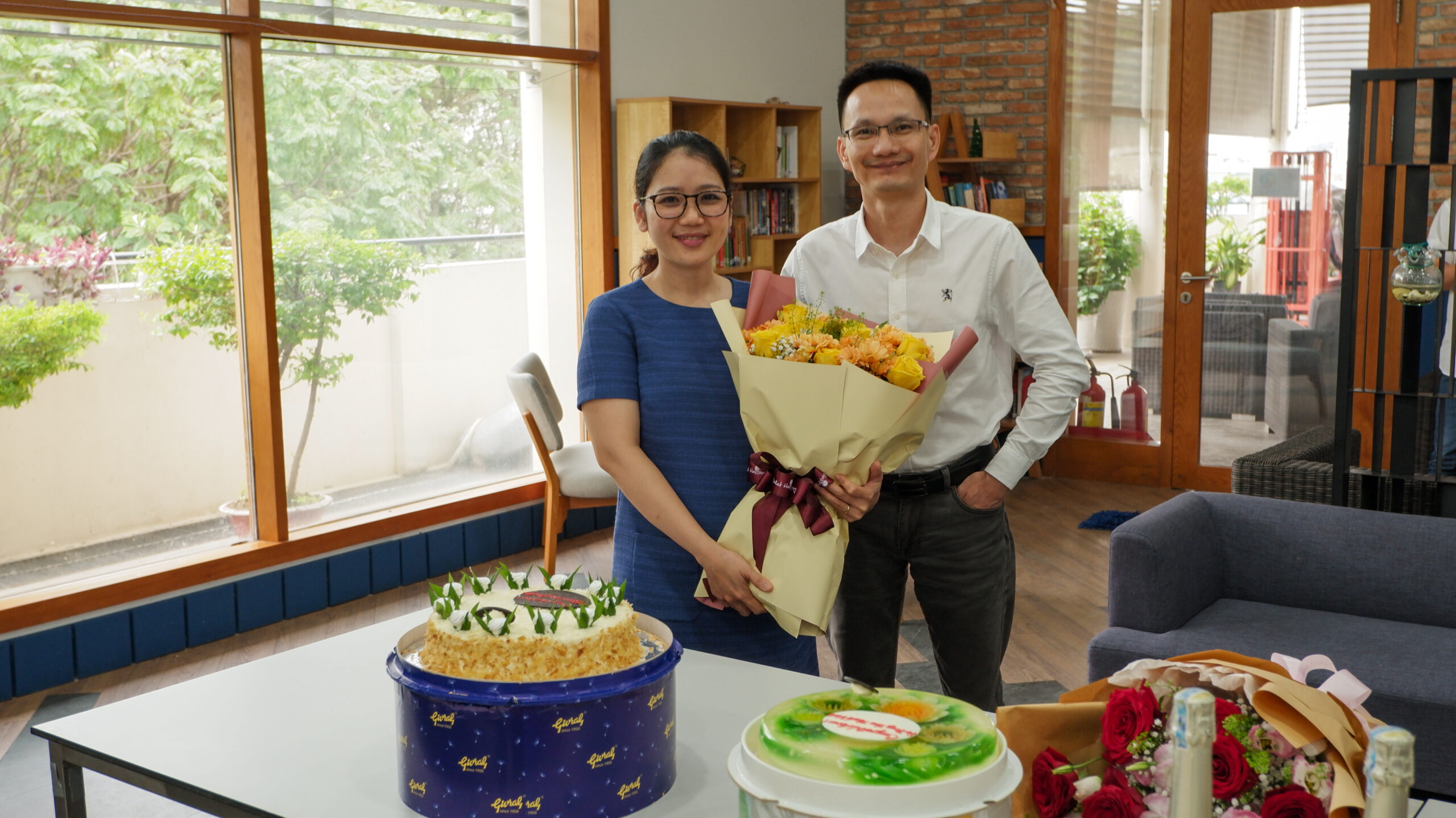
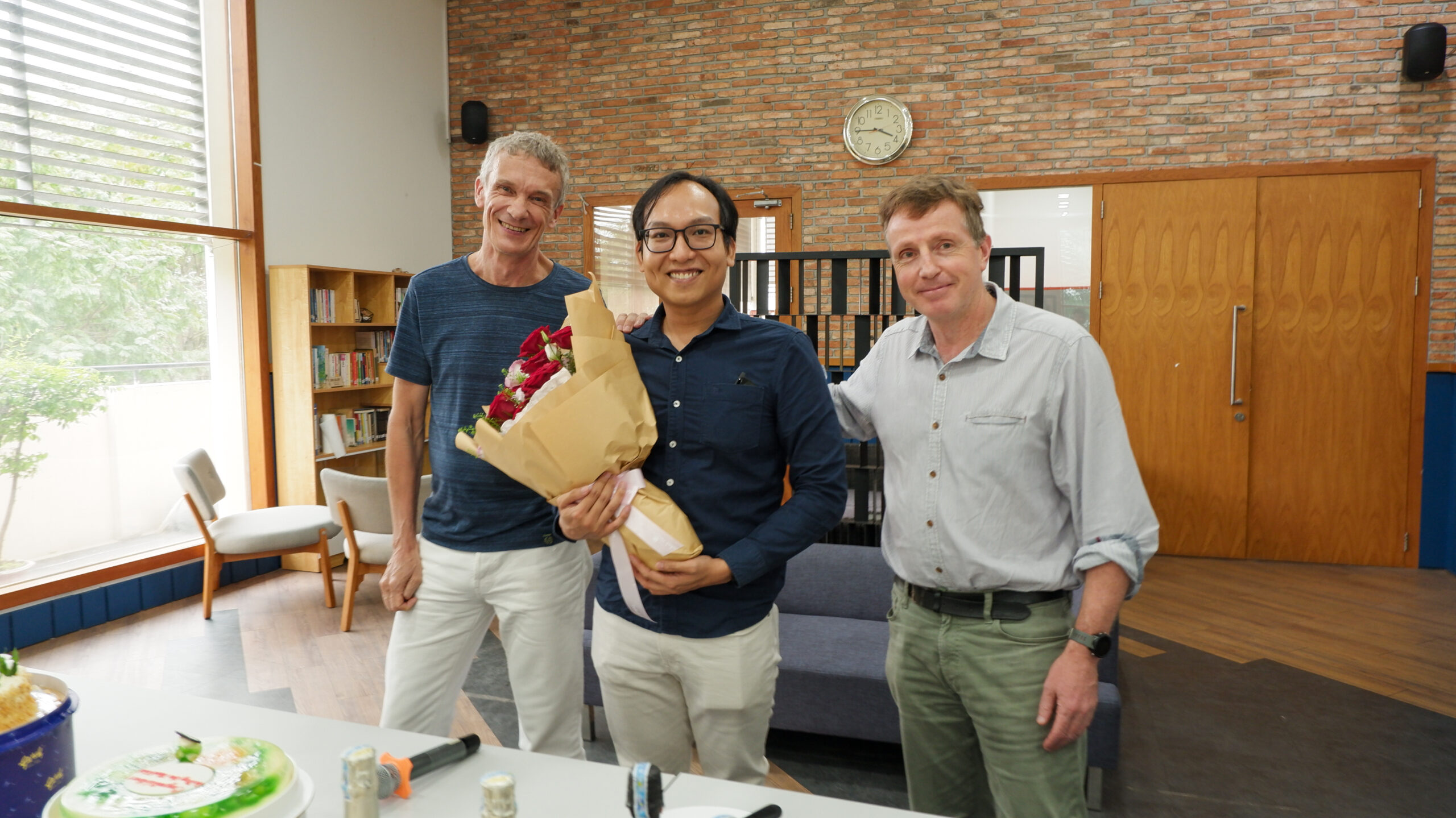
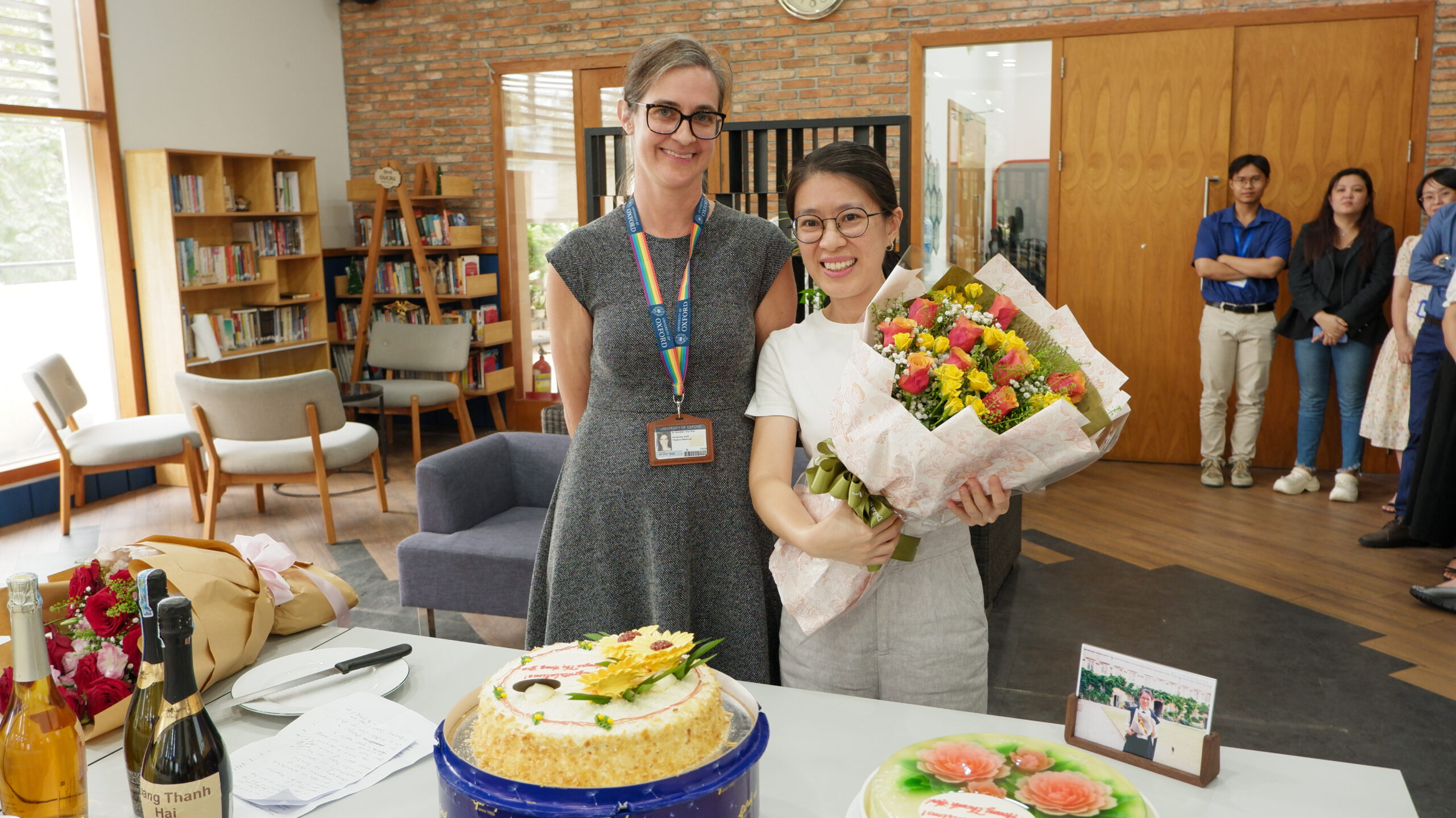
    OUCRU rất vui mừng được chúc mừng ba nghiên cứu sinh tiến sĩ đã hoàn thành xuất sắc chương trình tiến sĩ và đóng góp những nghiên cứu có giá trị cho sức khỏe toàn cầu.

    • Tiến sÄ© Hoàng Thanh Hải đã nghiên cứu cÆ¡ chế viêm cá»§a vật chá»§ trong cÆ¡ chế bệnh sinh, đáp ứng Ä‘iều trị và kết quả cá»§a viêm màng não do lao . Nghiên cứu cá»§a anh được hướng dẫn bởi Phó Giáo sư Nguyá»…n Thụy Thương Thương, Giáo sư Guy Thwaites và Tiến sÄ© Lê Thanh Hoàng Nhật thuá»™c Nhóm Nghiên cứu Lao tại OUCRU.
    • Tiến sÄ© Nguyá»…n Hoàng Thiên Hương đã nghiên cứu các đặc Ä‘iểm lâm sàng, nguyên nhân và gánh nặng kinh tế cá»§a bệnh viêm não trẻ em ở miền Nam Việt Nam . Cô được hướng dẫn bởi GS. Lê Văn Tấn (Nhóm Nghiên cứu Nhiá»…m trùng Má»›i nổi tại OUCRU), PGS.TS. Nguyá»…n Thanh Hùng (Bệnh viện Nhi đồng 1) và GS. Sarosh R. Irani (Đại học Oxford).
    • Tiến sÄ© Đồng Hữu Khánh Trình , dưới sá»± hướng dẫn cá»§a Giáo sư Guy Thwaites và Giáo sư Ronald B. Geskus, đã tiến hành nghiên cứu tiên phong về việc phát triển các công cụ và phương pháp má»›i để cải thiện chẩn Ä‘oán viêm màng não do lao .
    • Tiến sÄ© Nguyá»…n Thị Hồng Yến , dưới sá»± hướng dẫn cá»§a Phó Giáo sư Jennifer Ilo van Nuil, người có luận án Tiến sÄ© tập trung vào vấn đề tiếp cận thuốc kháng sinh không kê đơn ở các cá»™ng đồng nông thôn Việt Nam . Nghiên cứu cá»§a cô đã chỉ ra cách các yếu tố xã há»™i, cÆ¡ sở hạ tầng và chính trị định hình việc sá»­ dụng và quản trị thuốc kháng sinh, cung cấp những hiểu biết quan trọng để chống lại tình trạng kháng thuốc và cá»§ng cố chính sách y tế.

    Sự tận tâm và xuất sắc của họ thể hiện sứ mệnh của OUCRU là nuôi dưỡng tài năng khoa học và thực hiện nghiên cứu nhằm cải thiện cuộc sống trên khắp khu vực.

    Chào mừng nghiên cứu sinh tiến sĩ mới của OUCRU!

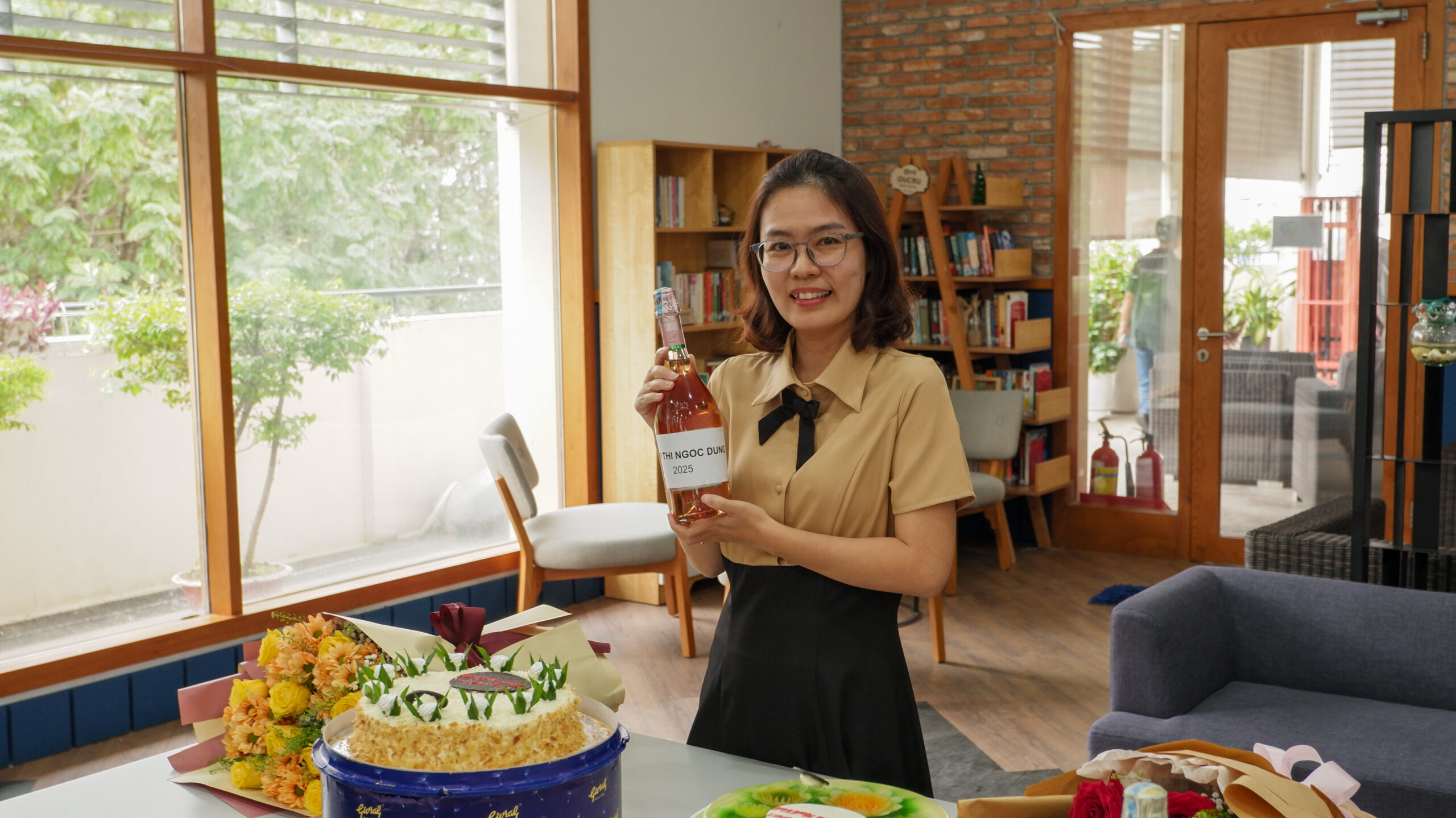
    OUCRU nồng nhiệt chào đón Trần Thị Ngọc Dung , người đã được trao Học bổng OUCRU cho Chương trình Tiến sĩ năm 2025. Tham gia Nhóm Dịch tễ học Phân tử, Dung sẽ tiếp nối truyền thống ham học hỏi khoa học, hợp tác và đổi mới của OUCRU.

    OUCRU chúc tất cả các nghiên cứu sinh tiến sĩ và học giả mới thành công trên hành trình phía trước — khi họ tiếp tục cùng nhau phát triển khoa học và sức khỏe toàn cầu.

  • Recognising OUCRU’s New PhD Graduates and Welcoming Future Scholar

    Recognising OUCRU’s New PhD Graduates and Welcoming Future Scholar

    Congratulations to our new PhD graduates! 

    We are delighted to congratulate our three PhD graduates for successfully completing their doctoral journeys and contributing valuable research to global health. 

    • Dr Hoàng Thanh Hải explored host inflammation in the pathogenesis, treatment response, and outcomes of tuberculous meningitis. His work was supervised by Assoc Prof Nguyá»…n Thụy Thương Thương, Prof Guy Thwaites, and Dr Lê Thanh Hoàng Nhật from the Tuberculosis Research Group at OUCRU. 
    • Dr Nguyá»…n Hoàng Thiên Hương studied the clinical features, causes, and economic burden of paediatric encephalitis in southern Vietnam. She was supervised by Prof Lê Văn Tấn (Emerging Infections Research Group at OUCRU), Assoc Prof Nguyá»…n Thanh Hùng (Children’s Hospital 1), and Prof Sarosh R. Irani (University of Oxford). 
    • Dr Đồng Hữu Khánh Trình, under the supevision of Prof Guy Thwaites and Prof Ronald B. Geskus, conducted pioneering research on developing new tools and approaches to improve the diagnosis of tuberculous meningitis
    • Dr Nguyá»…n Thị Hồng Yến, under the supervision of Associate Prof Jennifer Ilo van Nuil, whose DPhil focused on over-the-counter access to antibiotics in rural communities in Vietnam. Her research revealed how social, infrastructural, and political factors shape antibiotic use and governance, offering vital insights for combating antimicrobial resistance and strengthening health policy. 

    Their dedication and excellence embody OUCRU’s mission to nurture scientific talent and deliver research that improves lives across the region. 

    Welcome to our new PhD student! 

    We warmly welcome Trần Thị Ngọc Dung, who has been awarded the OUCRU Studentship for the Local PhD Programme 2025. Joining the Molecular Epidemiology Group, Dung will continue OUCRU’s tradition of scientific curiosity, collaboration, and innovation. 

    We wish all our PhD graduates and new scholars every success in their journeys ahead — as they continue advancing science and global health together. 

  • Chuá»—i tập huấn nâng cao năng lá»±c quản lý sá»­ dụng kháng sinh trong khuôn khổ nghiên cứu 60HN – ASPARNet

    Một trong những hoạt động nổi bật là chuỗi tập huấn nâng cao năng lực QLSDKS, do Bệnh viện Bệnh Nhiệt đới Trung ương và Đơn vị Nghiên cứu Lâm sàng Đại học Oxford (OUCRU), phối hợp với Sở Y tế Đồng Tháp, Sở Y tế Phú Thọ tổ chức.

    Chương trình tập huấn hướng đến mục tiêu nâng cao năng lực chuyên môn và thực hành về QLSDKS cho nhóm cán bộ y tế, hỗ trợ quá trình sử dụng kháng sinh hợp lý và kiểm soát kháng kháng sinh tại các cơ sở y tế. Thông qua các buổi tập huấn, cán bộ y tế được cập nhật các hướng dẫn điều trị mới nhất, củng cố kiến thức về vi sinh lâm sàng, dược lâm sàng và kiểm soát nhiễm khuẩn – những yếu tố nền tảng trong triển khai chương trình QLSDKS hiệu quả.

    Bên cạnh đó, chương trình còn chú trọng tăng cường năng lực nghiên cứu và triển khai thực tiễn các hoạt động QLSDKS tại bệnh viện, giúp các đơn vị chủ động xây dựng kế hoạch hành động phù hợp với điều kiện thực tế. Các buổi tập huấn cũng tạo điều kiện để các đơn vị trong mạng lưới trao đổi kinh nghiệm, học hỏi lẫn nhau, từ đó thúc đẩy sự phát triển đồng đều và bền vững của chương trình QLSDKS.

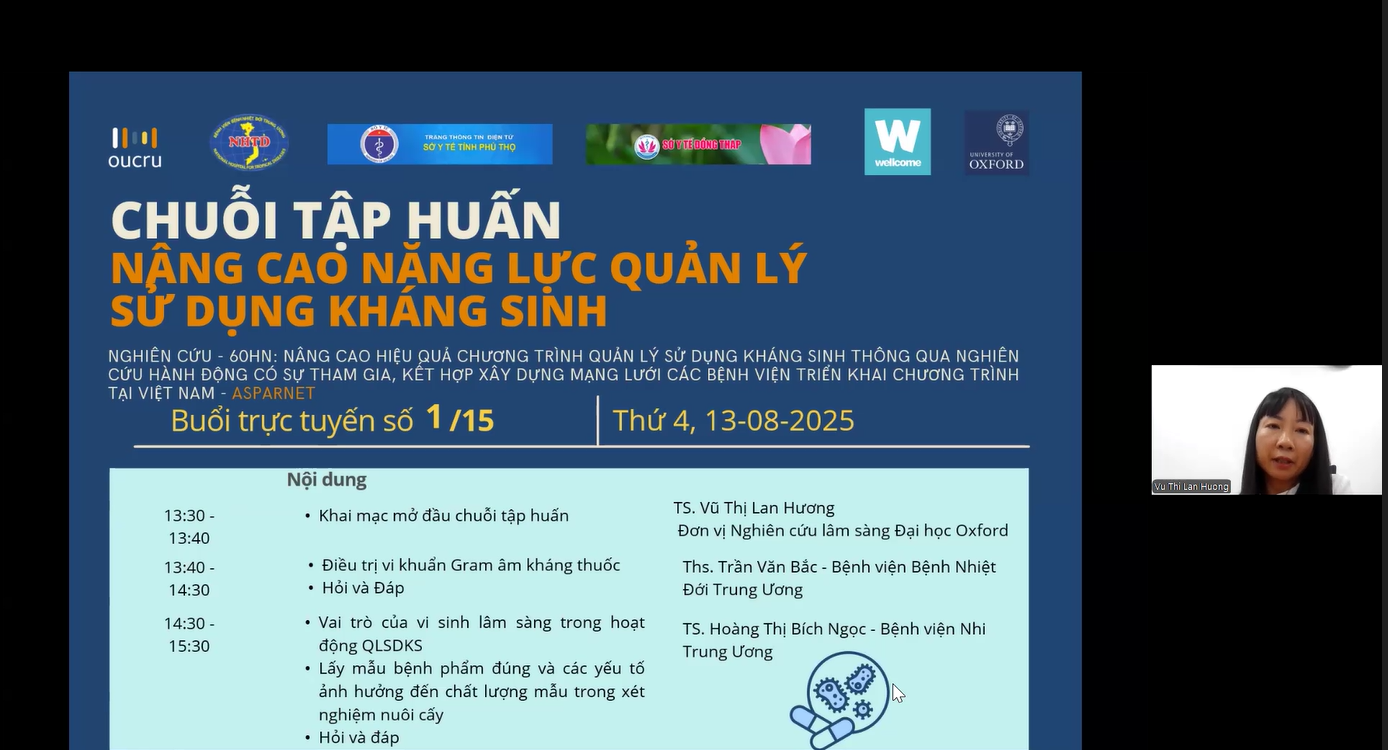
    Ảnh 1: TS. Vũ Thị Lan Hương – Nghiên cứu viên chính của nghiên cứu 60HN phát biểu khai mạc tập huấn (Nguồn: OUCRU)

    Nội dung của chuỗi tập huấn được xây dựng dựa trên các phương pháp của Nghiên cứu hành động có sự tham gia (PAR). Cách tiếp cận này thực hiện dựa trên nguyên tắc xây dựng từ sự tham gia chủ động của các bệnh viện và cán bộ y tế trong xác định nhu cầu đào tạo, phản hồi từ thực tiễn triển khai QLSDKS và hoạt động lâm sàng của các đơn vị tham gia nghiên cứu, gắn kết chặt chẽ giữa nghiên cứu khoa học và thực hành lâm sàng, đảm bảo giải pháp đưa ra phù hợp bối cảnh địa phương.

    Chuá»—i tập huấn vá»›i sá»± tham gia giảng dạy cá»§a các chuyên gia giàu kinh nghiệm đến từ các bệnh viện và trường đại học lá»›n như Bệnh viện Bệnh Nhiệt đới Trung ương, Bệnh viện Nhi Trung ương, Đại học Dược Hà Ná»™i, Đại học Y Hà Ná»™i, Bệnh viện Xanh Pôn,… Theo kế hoạch, mở đầu chuá»—i tập huấn là 01 buổi đào tạo trá»±c tiếp tại má»—i tỉnh vào tháng 07/2025, và chuá»—i 15 buổi đào tạo trá»±c tuyến bắt đầu từ tháng 7 năm 2025 và sẽ kéo dài đến tháng 6 năm 2026. Tính đến tháng 09/2025, 04 buổi tập huấn trá»±c tuyến đã được thá»±c hiện vá»›i sá»± tham gia cá»§a hÆ¡n 300 cán bá»™ y tế từ 12 đơn vị y tế thuá»™c nghiên cứu 60HN cÅ©ng như nhiều cÆ¡ sở y tế khác quan tâm đến chương trình quản lý sá»­ dụng kháng sinh.

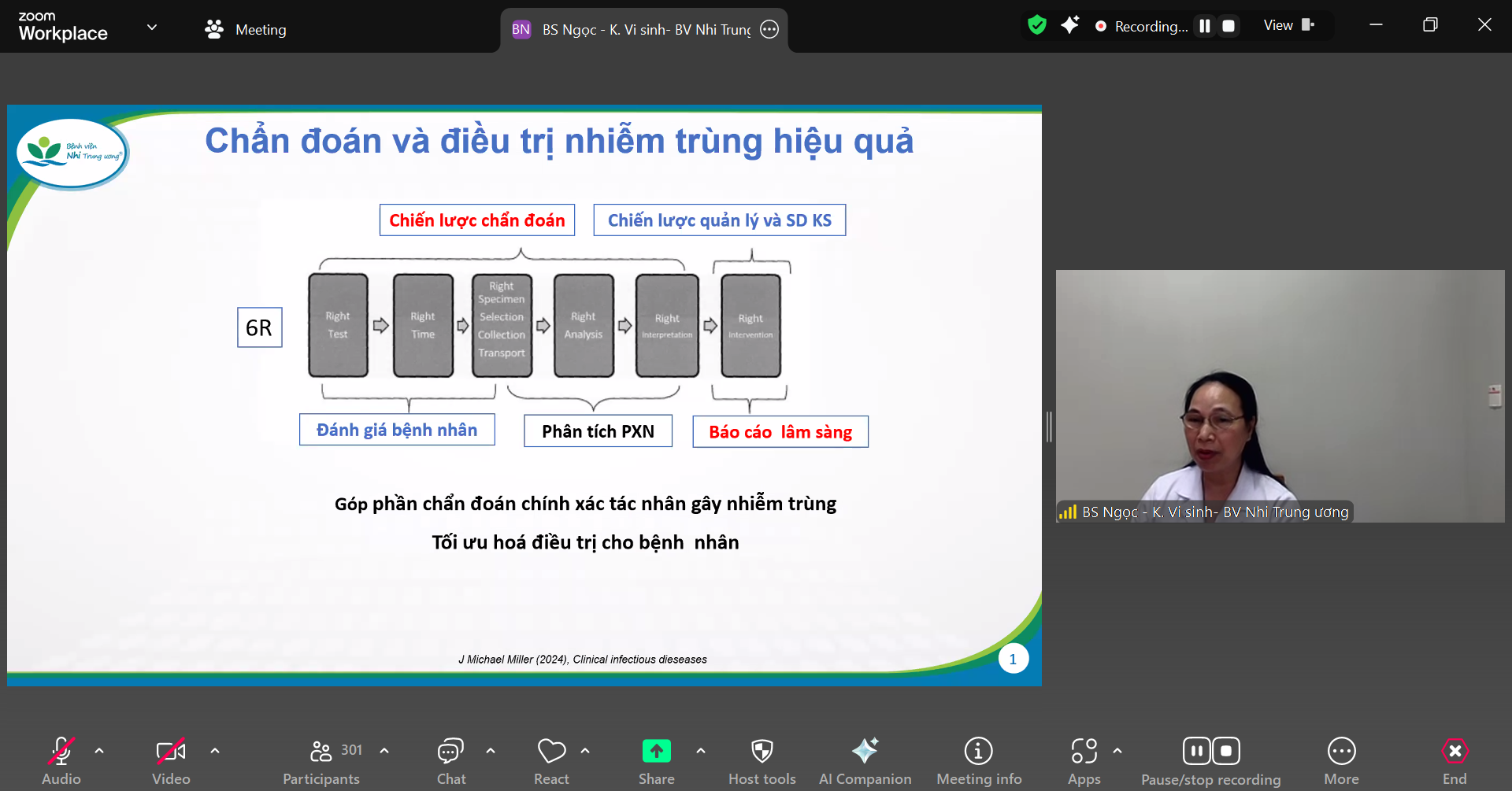
    Ảnh 2: Các buổi tập huấn thu hút sự quan tâm của đông đảo cán bộ y tế tham gia (Nguồn: OUCRU)

    Ngoài những nội dung tập trung vào việc củng cố kiến thức chuyên môn cho cán bộ y tế về sử dụng kháng sinh trong điều trị, vi sinh lâm sàng, dược lâm sàng, phân tích các nhóm vi khuẩn thường gặp và hướng dẫn xây dựng kế hoạch triển khai chương trình QLSDKS tại đơn vị, các giảng viên còn chia sẻ kinh nghiệm thực tế trong việc triển khai chương trình tại các bệnh viện, giúp các cán bộ y tế hiểu rõ hơn về các thách thức và giải pháp phù hợp trong từng bối cảnh cụ thể.

    Không chỉ dừng lại ở việc nâng cao năng lực chuyên môn cho cán bộ y tế, về lâu dài, những thay đổi trong thực hành kê đơn kháng sinh của bác sĩ sẽ góp phần thúc đẩy việc sử dụng kháng sinh hợp lý hơn, giúp giảm thiểu nguy cơ kháng thuốc, từ đó nâng cao hiệu quả điều trị, rút ngắn thời gian nằm viện và giảm chi phí y tế cho người bệnh. Đồng thời, kiểm soát tốt tình trạng kháng kháng sinh cũng góp phần bảo vệ sức khỏe cộng đồng, đặc biệt là trong bối cảnh các bệnh truyền nhiễm có nguy cơ bùng phát.

    Chương trình kỳ vọng sẽ hỗ trợ các đơn vị y tế xây dựng được kế hoạch nâng cao năng lực định kỳ cho đội ngũ cán bộ, duy trì và phát triển chương trình QLSDKS một cách hiệu quả, bền vững và thích ứng với sự chuyển đổi của hệ thống y tế. Đây là minh chứng cho sự phối hợp chặt chẽ giữa nghiên cứu khoa học và triển khai thực tiễn, góp phần nâng cao chất lượng điều trị và chăm sóc sức khoẻ tại Việt Nam.

  • Capacity-Building Training Series on Antimicrobial Stewardship within the 60HN – ASPARNet  

    One of the key activities within the 60HN – ASPARNet study is a capacity-building training series on antimicrobial stewardship (AMS), jointly organized by the National Hospital for Tropical Diseases (NHTD) and the Oxford University Clinical Research Unit (OUCRU), in collaboration with the Dong Thap and Phu Tho Departments of Health 

    The activity aims to enhance both the professional knowledge and practical skills of healthcare staff in antimicrobial stewardship (AMS), supporting rational antibiotic use and effective antimicrobial resistance (AMR) control in healthcare settings. Through the sessions, participants are updated on the latest treatment guidelines and strengthened in key areas such as clinical microbiology, clinical pharmacy, and infection control – essential components for successful AMS implementation. 

    In addition, this activity places strong emphasis on building research capacity and supporting the practical implementation of AMS activities at hospitals, enabling each unit to proactively develop action plans tailored to their specific context. The training sessions also serve as a platform for experience sharing among hospitals within the network, fostering mutual learning and promoting the sustainable and equitable development of the AMS programs. 

    Picture 1: Dr. Vu Thi Lan Huong – Principal investigator of 60HN delivered the opening speech of the training course (Source: OUCRU) 

    The content of the training course is developed based on the principles of Participatory Action Research (PAR). This approach emphasizes active involvement from hospitals and healthcare staff in identifying training needs, providing feedback from real-world AMS implementation and clinical practice, and ensuring a strong connection between scientific research and clinical application. By grounding the training in local realities, this activity aims to deliver context-appropriate and practical solutions. 

    The training series features experienced lecturers from leading hospitals and universities, including the National Hospital for Tropical Diseases, the Vietnam National Children’s Hospital, Hanoi University of Pharmacy, Hanoi Medical University, Saint Paul Hospital, etc. According to the plan, the series began with one in-person training session in each province in July 2025, followed by a total of 15 virtual sessions running from July 2025 to June 2026. As of September 2025, four online training sessions have been conducted, with participation from over 300 healthcare staff from 12 network hospitals involved in the 60HN study, as well as many other healthcare facilities interested in AMS implementation. 

    Picture 2: Healthcare staff participated in the training series (Source: OUCRU) 

    In addition to strengthening healthcare professionals’ knowledge in clinical antibiotic use, clinical microbiology, clinical pharmacy, analysis of common bacterial groups, and guidance on developing AMS implementation plans at their respective institutions, the training sessions also feature practical experience sharing by lecturers who have directly implemented AMS programs in their hospitals. These insights help participants better understand the challenges and identify context-specific solutions tailored to the realities of each healthcare setting. 

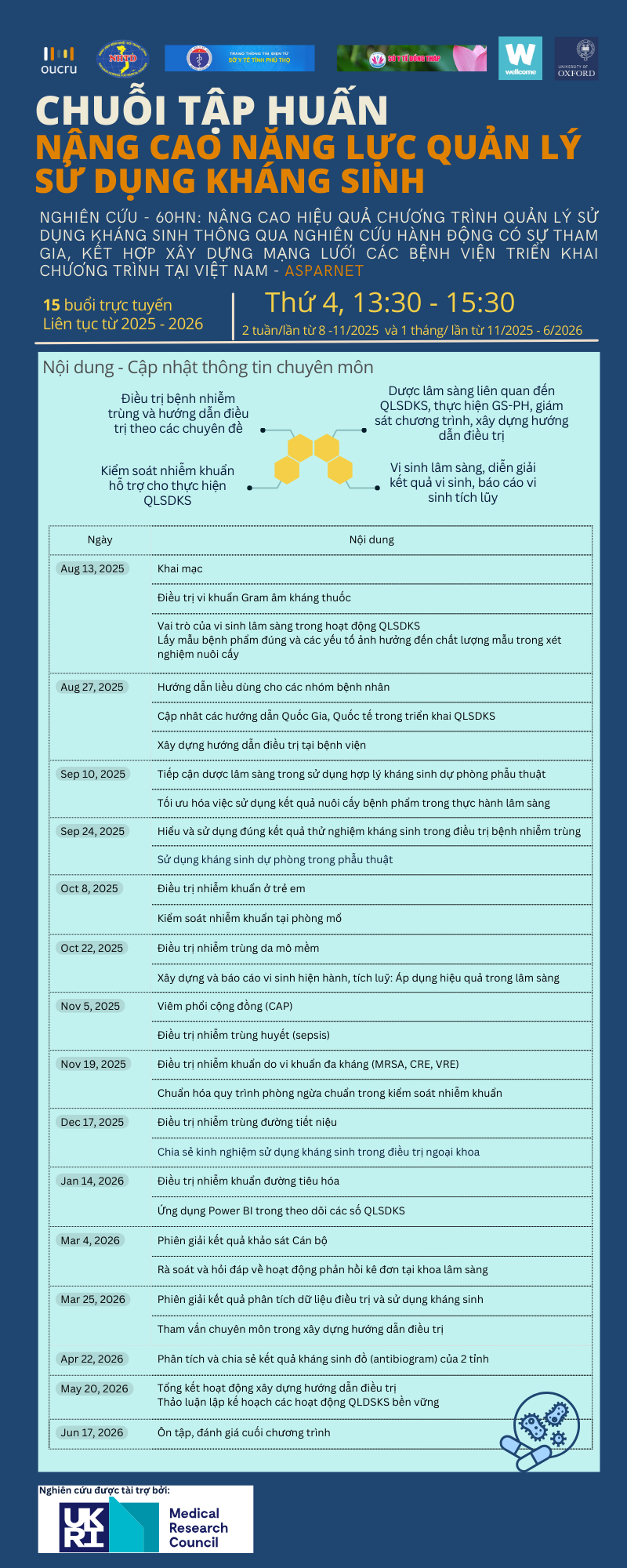
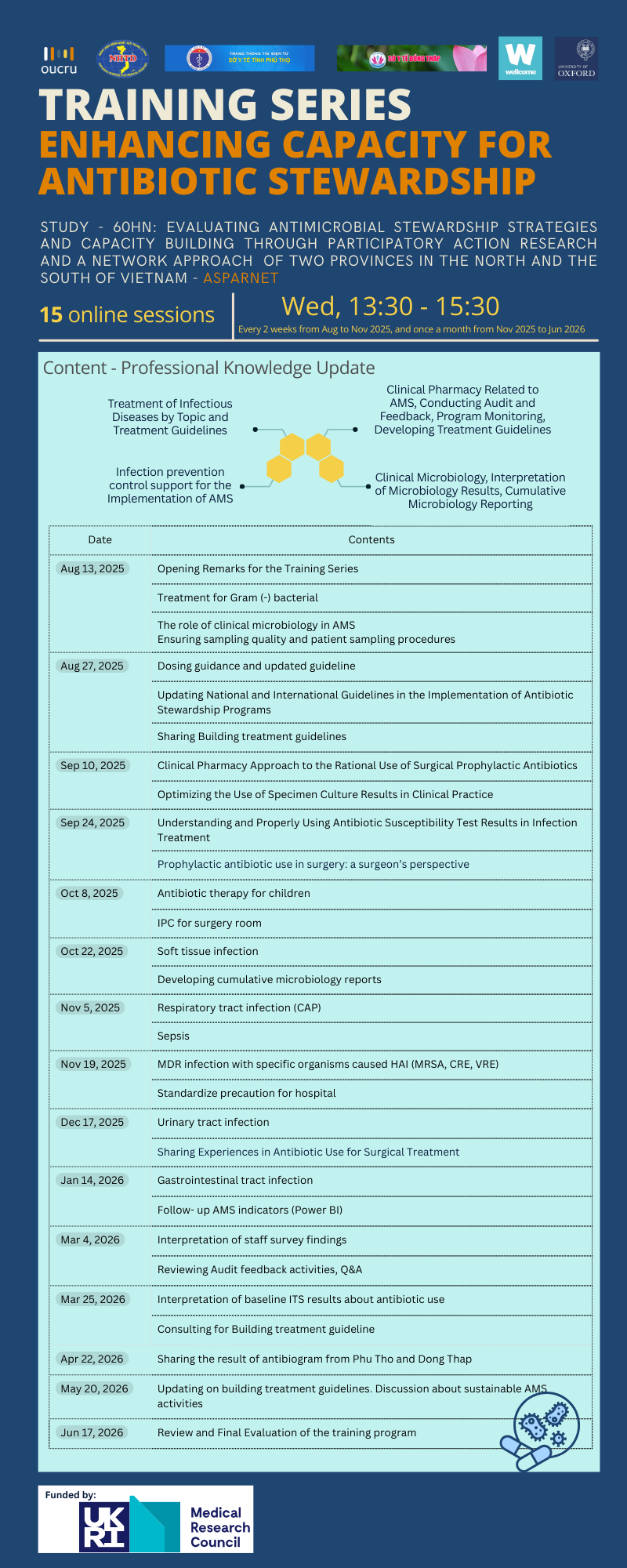
    Picture 3: Content of training series to improve capacity in antibiotic stewardship (Source: OUCRU) 

    Beyond enhancing the professional capacity of healthcare staff, the activity is expected to drive long-term changes in antibiotic prescribing practices among clinical doctors. These changes will contribute to more appropriate antibiotic use, helping to reduce the risk of antimicrobial resistance, improve treatment outcomes, shorten hospital stays, and lower healthcare costs for patients. Effective AMR control also plays a vital role in safeguarding public health, especially in the context of emerging infectious disease threats. 

    In the long run, the program aims to support healthcare institutions in developing regular capacity-building plans for their staff, ensuring the sustainable and effective implementation of AMS initiatives. This effort reflects a strong integration between scientific research and practical application, contributing to improved quality of care and health outcomes in Vietnam. 

  • Há»™i thảo AWARE: Thúc đẩy đối thoại về hệ thống cảnh báo sá»›m dịch bệnh do biến đổi khí hậu

    Hội thảo AWARE: Thúc đẩy đối thoại về hệ thống cảnh báo sớm dịch bệnh do biến đổi khí hậu

    Việt Nam là một trong những quốc gia chịu ảnh hưởng nặng nề nhất bởi các hiện tượng thời tiết cực đoan, tạo điều kiện cho dịch bệnh lây lan nhanh chóng. Nắng nóng và độ ẩm kéo dài là môi trường lý tưởng để muỗi sinh sôi, thúc đẩy mạnh mẽ bệnh sốt xuất huyết và các bệnh do côn trùng (vector) truyền khác. Thiên tai, lũ lụt cũng làm tăng nguy cơ mắc các bệnh lây truyền qua đường nước và đường tiêu hóa. Những rủi ro dịch bệnh nhạy cảm với khí hậu này cho thấy nhu cầu cấp bách phải có các hệ thống cảnh báo và ứng phó sớm để bảo vệ sức khỏe người dân.

    Tại OUCRU Việt Nam, nhóm nghiên cứu do Phó Giáo sư Jennifer Ilo Van Nuil và Tiến sĩ Marc Choisy dẫn dắt, đã thực hiện nghiên cứu chuyên sâu nhằm đánh giá cách tăng cường các hệ thống cảnh báo và phản ứng nâng cao (AW&R) để đối phó với sốt xuất huyết và các bệnh truyền nhiễm khác. Nghiên cứu xác định các rào cản và yếu tố thuận lợi khi tích hợp các công cụ cảnh báo sớm, như Công cụ chuẩn bị nâng cao cho sốt xuất huyết (DART) của OUCRU, vào hệ thống giám sát hiện có.

    Nghiên cứu này là một phần của dự án toàn cầu Advance Warning and Response Exemplars (AWARE), được triển khai từ 2023–2025, do Trung tâm Đại dịch của Đại học Brown (Hoa Kỳ) dẫn dắt và được tài trợ bởi Quỹ Gates, Gates Ventures và Wellcome. OUCRU Việt Nam là một trong bốn đối tác nghiên cứu địa phương, bên cạnh Brazil, Kenya và Nam Phi.

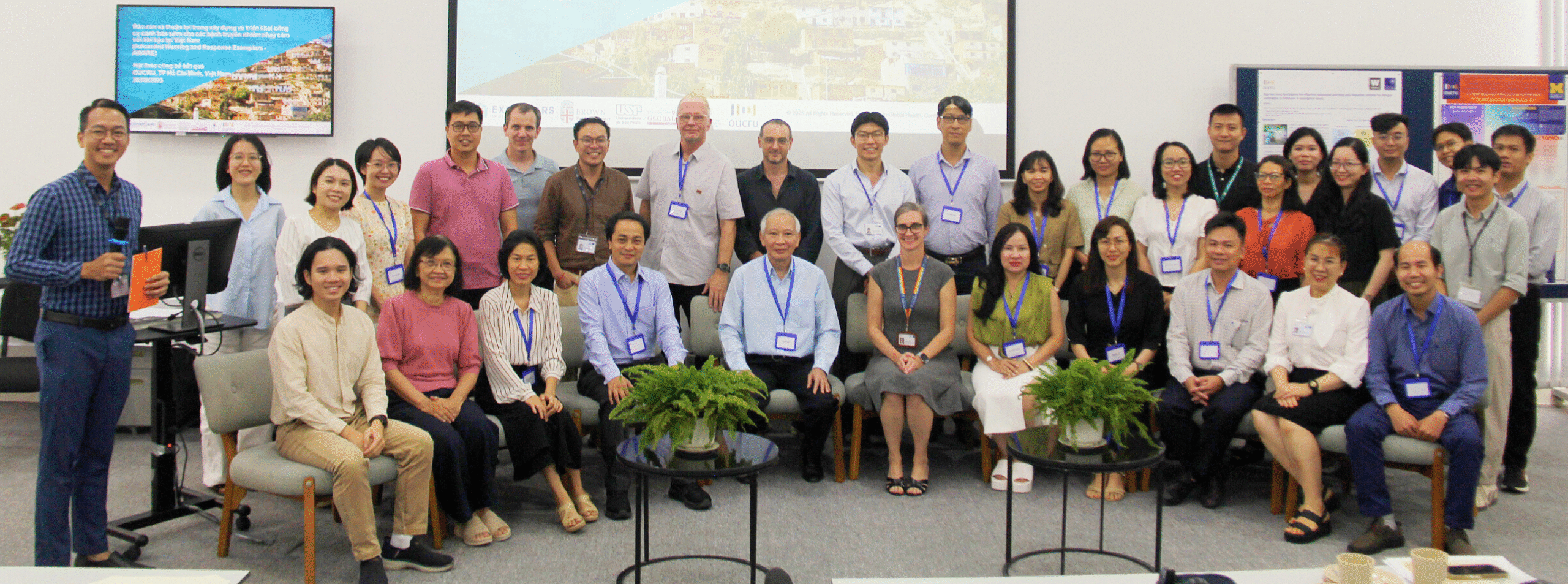
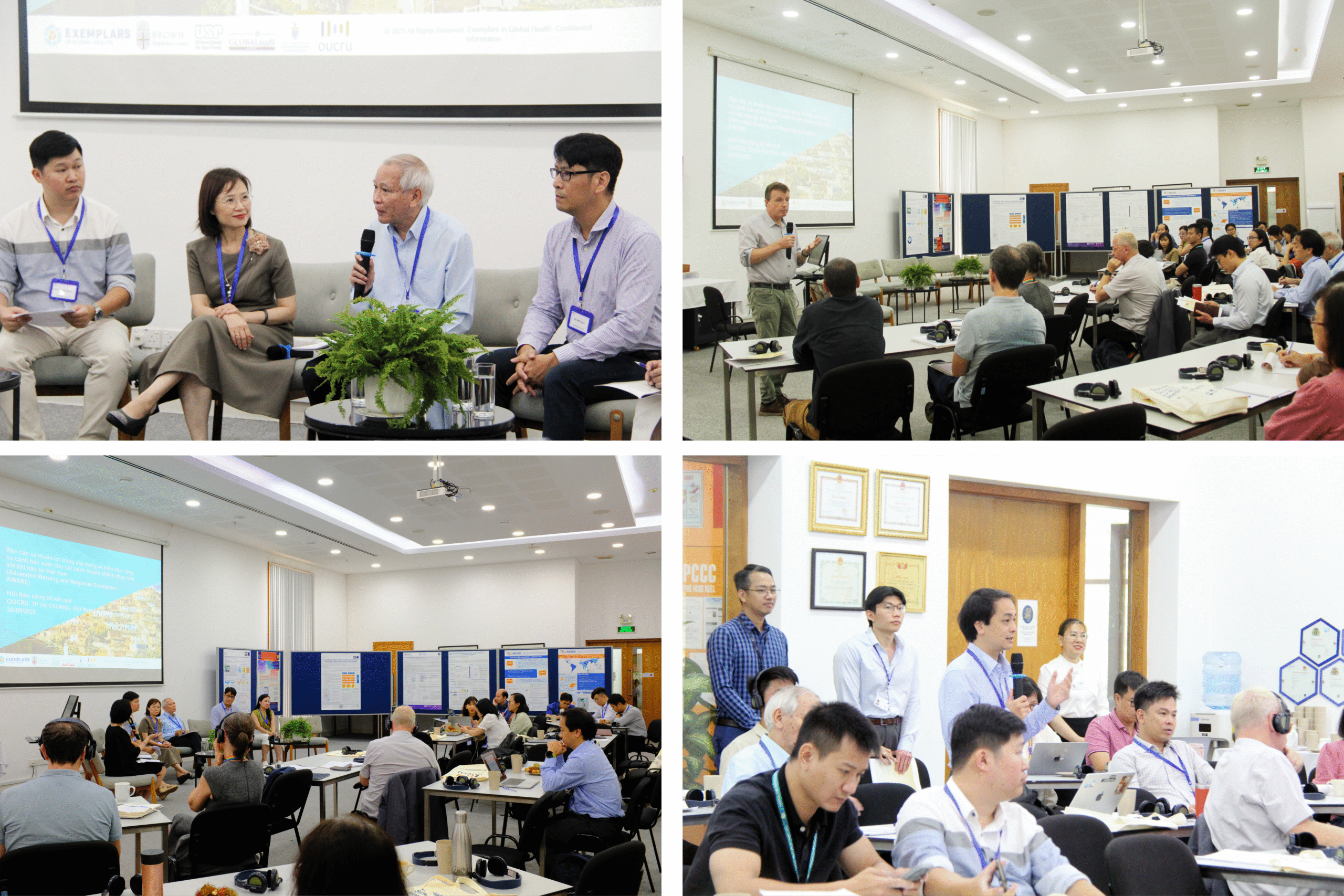
    Hội thảo công bố kết quả được tổ chức vào ngày 30 tháng 9, đã trình bày các kết quả nghiên cứu tại Việt Nam. Khoảng 30 đại biểu từ Sở Y tế, Trung tâm Kiểm soát Bệnh tật thành phố Hà Nội và thành phố Hồ Chí Minh, Viện Vệ sinh Dịch tễ Trung ương, Viện Pasteur TP. Hồ Chí Minh và các bệnh viện hàng đầu cũng đã thảo luận về cơ hội cải thiện khả năng dự đoán và phản ứng nhanh với dịch bệnh.


    Trước sự phức tạp ngày càng tăng của các bệnh truyền nhiễm do biến đổi khí hậu, các đại biểu thống nhất rằng Việt Nam có cả cơ hội và trách nhiệm để đi đầu trong việc thúc đẩy các hệ thống cảnh báo và phản ứng sớm, mang lại những bài học có giá trị quốc tế.

    GS Guy Thwaites, Giám đốc OUCRU, nhấn mạnh tầm quan trọng của hệ thống giám sát dịch bệnh tại Việt Nam: “Nhiều ca bệnh truyền nhiễm mới nổi đã được phát hiện tại Bệnh viện Bệnh Nhiệt đới ở TP. Hồ Chí Minh. Bằng cách tổng hợp chuyên môn và dữ liệu trên toàn quốc, chúng ta có thể tiến xa hơn nữa, từ một hệ thống giám sát tốt trở thành khả năng dự đoán dịch bệnh còn mạnh mẽ và hiệu quả hơn.”

    PGS Jennifer Van Nuil, Chủ nhiệm Nghiên cứu tại OUCRU, nhấn mạnh sự công nhận quốc tế đối với Việt Nam: “Chúng tôi đã dành nhiều năm để tìm hiểu những điểm mạnh và thách thức của hệ thống ứng phó dịch bệnh tại Việt Nam. Thông qua Dự án AWARE, Việt Nam đang được công nhận trên toàn cầu là một hình mẫu về khả năng sẵn sàng ứng phó dịch bệnh. Thành quả này có được nhờ sự hợp tác giữa các nhóm khoa học xã hội, mô hình toán học và nghiên cứu sốt xuất huyết của OUCRU, cùng với các đối tác. Nghiên cứu của chúng tôi không chỉ nhằm mục đích hiểu các rào cản, mà còn là xác định những phương pháp hiệu quả và tiềm năng nhân rộng chúng.”

    Ý nghĩa Quốc tế

    Dá»± án AWARE được lấy cảm hứng từ chương trình COVID-19 Response Exemplars in Global Health, nhấn mạnh tầm quan trọng cá»§a việc phát hiện sá»›m và phản ứng phối hợp trước dịch bệnh. Bằng cách nghiên cứu các “Ä‘iểm sáng” ở các quốc gia thu nhập thấp và trung bình, AWARE xác định những thá»±c hành tốt nhất và các năng lá»±c cốt lõi giúp hệ thống cảnh báo và phản ứng nâng cao (AW&R) vận hành hiệu quả.

    Tại Việt Nam, dự án tập trung vào phòng chống và kiểm soát sốt xuất huyết Dengue, một thách thức lớn khi biến đổi khí hậu làm tăng tần suất và mức độ nghiêm trọng của dịch bệnh. Kết quả nghiên cứu của OUCRU sẽ đóng góp vào việc hoạch định chính sách dựa trên bằng chứng, hỗ trợ hợp tác đa ngành, và tăng cường tích hợp các công cụ dự báovào hệ thống giám sát bệnh truyền nhiễm quốc gia.

  • OUCRU workshop drives dialogue on early warning systems for climate-sensitive infectious diseases  

    OUCRU workshop drives dialogue on early warning systems for climate-sensitive infectious diseases  

    Vietnam is among the countries most affected by extreme weather, which fuels the spread of infectious diseases. Prolonged heat and humidity create ideal conditions for mosquitoes to breed, driving dengue and other vector-borne illnesses. Flooding, meanwhile, increases exposure to waterborne and digestive diseases. Together, these climate-sensitive risks underline the urgent need for early warning and response systems to protect public health. 

    A research team at OUCRU Vietnam, led by Associate Professor Jennifer Ilo Van Nuil and Dr Marc Choisy, has been conducting in-depth qualitative research to examine how advanced warning and response (AW&R) systems can be strengthened to address dengue and other climate-sensitive infectious diseases. The study identifies barriers and facilitators for integrating early warning tools, such as OUCRU’s Dengue Advanced Readiness Tools (DART), into existing surveillance systems. 

    This research is part of the  Advance Warning and Response Exemplars (AWARE) project, a three-year global initiative (2023–2025) led by Brown University’s Pandemic Centre and funded by the Gates Foundation, Gates Ventures, and Wellcome. OUCRU Vietnam is one of four in-country research partners, alongside Brazil, Kenya, and South Africa. 

    On 30 September, a dissemination workshop was organised to share the Vietnam site findings. Participants, around 30 representatives from the Department of Health, the Centres for Disease Control in Hanoi and Ho Chi Minh city, the National Institute of Hygiene and Epidemiology, Pasteur Institute Ho Chi Minh City, and leading hospitals, also discussed opportunities to improve outbreak prediction and rapid response.  

    As infectious diseases grow increasingly complex in the face of climate change, participants agreed that Vietnam has both the opportunity and responsibility to lead by example in advancing early warning and response systems, offering lessons with global relevance. 

    Prof Guy Thwaites, Director of OUCRU, underlined the importance of building on Vietnam’s strong disease surveillance system: “Many emerging infectious diseases in Vietnam are first detected here at the Hospital for Tropical Diseases in Ho Chi Minh City. Bringing together expertise and data from across the country, we can move from strong surveillance to even stronger outbreak prediction.”  

    Assoc Prof Jennifer Van Nuil, Principal Investigator at OUCRU, emphasised Vietnam’s international recognition: “We have spent the past year exploring the strengths and challenges of Vietnam’s response systems. Through AWARE, Vietnam is being recognised globally as a model for outbreak preparedness, thanks to the collaborative work of OUCRU’s social science, mathematical modeling, and dengue research teams, alongside our partners at HTD. This research is not only about understanding barriers, but also about identifying what works and scaling it.” 

    Global significance 

    The AWARE project was inspired by the COVID-19 response Exemplars in Global Health programme, which underscored the importance of rapid detection and coordinated responses. By examining “positive outliers” in low- and middle-income countries, AWARE aims to identify best practices and core capacities that enable effective AW&R systems. 

    In Vietnam, the project focuses on dengue prevention and control, a pressing challenge as climate change drives more frequent and severe outbreaks. OUCRU’s findings will contribute to evidence-based policymaking, support multi-sectoral collaboration, and strengthen the integration of predictive tools into the national infectious disease surveillance system.