Author: Tuyet Anh Tran

  • The world is facing a shortage of 11 million health workers by 2030(*)

    The world is facing a shortage of 11 million health workers by 2030(*)

    World Health Worker Week (#WHWWeek) highlights the importance of the health workforce – nurses, pharmacists, epidemiologists, doctors, community health workers/volunteers, technicians, and their colleagues – the heart of global health.

    Led by the Frontline Health Workers Coalition, #WHWWeek calls for increased investment in all cadres of the health workforce and advocates for prioritizing human resources for health on the global agenda. It is an opportunity to highlight the crucial role that sustained leadership and long-term investments in the health workforce play in achieving resilient health systems and advancing development goals.

    #healthworkerssavelives and foster healthier communities by managing illness, preventing the spread of disease, providing education, among other things. In doing so, health workers also help drive economies – protecting the health of employees, reducing absenteeism and otherwise helping people thrive. Let’s make sure all cadres of health workers are compensated, protected, retained and succeed so that they can continue to help people live healthier, more productive lives.

    Key Messages

    Strengthen the health workforce.

    By 2030, there will be a shortage of 11 million health workers, predicted by WHO. Increased investment in the health workforce is not only necessary; it is a wise and worthwhile strategy to strengthen global health and achieve development targets. Well-trained, protected, and fairly compensated health workers lie at the core of health care.

    Investments in health workers deliver returns.

    Donors from philanthropic organizations, foundations, multilaterals, banks, and private sector must help close the existing gap in health workforce funding. This investment benefits business, the economy, and broader development goals.

    • Building resilient health systems requires prioritising long-term investment in health workers with essential resources and training.
    • Poor health costs 15% of global real GDP annually, making health investment economically vital.
    • Health workforce investment could extend global life expectancy by 3.7 years and save 60 million lives by 2030.

    Protect health workers, who protect our health.

    Health workers serve as frontline preventers and providers of essential health services. Their physical and mental wellbeing must be protected to ensure optimal community care.

    • Achieving SDG 3 (Good Health and Well-Being) requires a strong health workforce, supported by aligned global financing and implementation strategies.
    • Over 60% of health workers face workplace violence. Combined with poor working conditions and low pay, this leads to high turnover rates.

    Value health workers, who facilitate good health and contribute to economic growth.

    Health workers are the heart of global health security, preventing and responding to pandemics, infectious diseases, NCDs, and maternal-child health challenges.

    • Beyond improving community health, they are active contributors to global GDP by enabling a more productive workforce and reducing absenteeism.
    • With women comprising 70% of health workers and over 75% of unpaid healthcare labor, fair compensation and advancement opportunities are essential.

    Supporting and strengthening healthcare workers’ capacity has been central to OUCRU’s Public and Community Engagement group’s missions. As a clinical research unit, healthcare workers are essential to OUCRU’s operations and research. Working closely with them, we acknowledge and understand their unique challenges—structural, physical, and mental. Our support programme includes capacity training, mental health support, partnership opportunities, and much more.

    One highlight of our healthcare worker strengthening program is a collaboration between OUCRU and Dak Lak’s Department of Health and Centre for Disease Control (CDC) to develop a training package to enhance the capacity of commune vaccine staff, particularly focusing on supporting their communication about vaccines and the vaccination process.

    Communes that participated in the training programme saw up to a 42% increase in booster vaccination uptake compared to the communes that did not participate.

    “Before the training was implemented, 52 out of 184 communes in Dak Lak fell behind on vaccination. […] Capacity building for frontline health workers is now more important than ever.” 

    Dr Le Phuc, Vice Director of Dak Lak CDC, said during the progress meeting organised in May, 2023.

    To make our training materials accessible, the Public and Community Engagement Group (PCE) partners with The Global Health Network (TGHN) to manage CONNECT, a knowledge and training hub that provides resources for healthcare workers in Vietnam and globally, particularly in research context. Through CONNECT, healthcare workers can access recordings of webinars covering several topics, including emotional communication competence, compassion fatigue, and grief in neonatal care contexts. All materials on CONNECT are freely available to access and download. You can also subscribe here for monthly updates.

    Read more about Public and Community Engagement Group’s healthcare engagement programme here.

    (*) https://www.frontlinehealthworkers.org/world-health-worker-week-2025
  • 1/3 thuốc kháng sinh sá»­ dụng ở Việt Nam là ‘không phù hợp’

    1/3 thuốc kháng sinh sử dụng ở Việt Nam là ‘không phù hợp’

    Đứng thứ 11 trên toàn cầu về lượng tiêu thụ thuốc kháng sinh, Việt Nam đứng trước nguy cơ kháng thuốc nghiêm trọng, ‘không còn thuốc chữa do kháng kháng sinh’.

    Theo thống kê, 79% kháng sinh sử dụng ở Việt Nam ngoài phạm vi liều lượng khuyến cáo và trong nhiều trường hợp, kháng sinh được kê một cách không cần thiết(*).

    Các nhà khoa học cũng nêu thực trạng phần lớn thuốc kháng sinh ở nước ta được bán không có đơn của bác sĩ, trong khi nhiều người bán không đủ trình độ và kinh nghiệm nhưng vẫn tự ý kê thuốc cho người dân. Nhiều trường hợp cảm lạnh thông thường tự mua kháng sinh về sử dụng.

    Trong bối cảnh nguồn lực hạn chế, các bác sĩ phải đối mặt với nhiều thách thức. Gần một nửa bác sĩ tham gia khảo sát cho biết các chương trình đào tạo được thực hiện không đầy đủ. Lỗ hổng kiến thức và kỳ vọng của bệnh nhân cũng góp phần vào tình trạng này. Một nghiên cứu của OUCRU tiến hành tại 3 bệnh viện tuyến cuối cho thấy 50% bác sĩ được khảo sát thừa nhận tình trạng kê kháng sinh thường xuyên và nhiều hơn mức cần thiết.

    Để cải thiện tình trạng kháng kháng sinh ở Việt Nam, nhà nước đã có các chương trình quản lý kháng sinh được triển khai từ năm 2016. Nhằm giúp tìm hiểu sâu hơn các yếu tố ảnh hưởng đến quyết định sử dụng kháng sinh trong bối cảnh bệnh viện ở Việt Nam, nhóm nghiên cứu tại OUCRU đã thực hiện khảo sát kiến thức, thái độ và (hành vi) hoạt động kê đơn thuốc kháng sinh giữa các bác sĩ BV tuyến cuối ở Việt Nam nhằm góp phần hỗ trợ định hướng phát triển các biện pháp can thiệp và chính sách có mục tiêu để thúc đẩy sử dụng kháng sinh hiệu quả hơn, giảm thiểu các hậu quả không mong muốn của sử dụng kháng sinh, và bảo vệ hiệu quả của thuốc trong tương lai.

    Hiểu thêm về chương trình quản lý kháng sinh ở Việt Nam dưới góc nhìn giới trẻ

    Trong Viện Y khoa Woolcock trích dẫn theo một nghiên cứu về sử dụng kháng sinh không theo đơn trên toàn cầu, tỷ lệ tự mua thuốc kháng sinh tại cộng đồng ở Việt Nam là 62%, cao hơn nhiều so với các nước như Trung Quốc là 36%, Indonesia 17%, Ấn Độ 18%, còn Anh chỉ 3%. Một trở ngại trong việc thay đổi hành vi sử dụng kháng sinh tại bệnh viện và cộng đồng là kỳ vọng của bệnh nhân có thể gây áp lực lên bác sĩ và sử dụng kháng sinh không cần thiết.

    Tuy nhiên, quản lý kháng sinh là một khái niệm không phổ biến đối với công chúng do chủ yếu được truyền thông trong các hội nghị quốc gia và quốc tế. Để hỗ trợ phổ biến khái niệm này cũng như góp phần vào việc nâng cao nhận thức về kháng sinh trong cộng đồng, Collab Lab đã thực hiện tóm tắt nghiên cứu quan trọng này.

    Sử dụng góc nhìn thú vị ‘cuộc chiến bàn phím’ giữa bác sĩ và vi khuẩn, video của Collab Lab mang lại góc nhìn dễ hiểu và trực quan, giúp công chúng dễ dàng hiểu được tầm quan trọng của quản lý kháng sinh và sử dụng kháng sinh hợp lý.

    Đón xem video của Collab Lab này trên các kênh truyền thông đại chúng của OUCRU và tại trang dự án Collab Lab.

    Tham khảo:

    (*) https://vnexpress.net/nguy-co-khong-con-thuoc-chua-do-khang-khang-sinh-4530533.html

  • One-third of antibiotics used in Vietnam are ‘inappropriate’

    One-third of antibiotics used in Vietnam are ‘inappropriate’

    Ranking 11th globally in antibiotic use, Vietnam faces a serious risk of drug resistance, ‘running out of treatment options due to antibiotic resistance’.

    According to statistics, treatment options due to antibiotic resistance’, 79% of antibiotics taken in Vietnam are over the recommended level, and antibiotics are most often prescribed unnecessarily(*).

    Scientists also highlight the fact that most antibiotics in our country are sold without prescriptions, while many sellers lack proper qualifications and experience but still prescribe medications to people independently. Several people self-medicate common colds with antibiotics.

    In the context of limited resources, doctors face numerous challenges. Nearly half of the surveyed doctors reported that there is lack of training programmes. Knowledge gaps and patient expectations also contribute to this situation. A study by OUCRU conducted at 3 tertiary hospitals showed that 50% of surveyed doctors admitted to prescribing antibiotics frequently and more than necessary.

    To improve the antibiotic resistance situation in Vietnam, the government has implemented antibiotic stewardship programs since 2016. To better understand the factors influencing antibiotic use decisions in Vietnamese hospital settings, the research team at OUCRU conducted a survey on knowledge, attitudes, and prescribing practices among doctors at tertiary hospitals in Vietnam, aiming to help guide the development of targeted interventions and policies to promote more effective antibiotic use, minimize unwanted consequences of antibiotic use, and preserve drug effectiveness for the future.

    Understanding Vietnam’s antibiotic stewardship program from youth perspectives

    According to the Woolcock Medical Institute, citing a global study on non-prescription antibiotic use, the rate of self-purchased antibiotics in Vietnamese communities is 62%, significantly higher than countries like China at 36%, Indonesia 17%, India 18%, while the UK is only 3%. One obstacle in changing antibiotic use behavior in hospitals and communities is that patient expectations can pressure doctors into unnecessary antibiotic prescriptions.

    However, antibiotic stewardship remains an unfamiliar concept to the public as it is mainly discussed at national and international conferences. To help popularise this concept and contribute to raising awareness about antibiotics in the community, Collab Lab has created a summary of this important research.

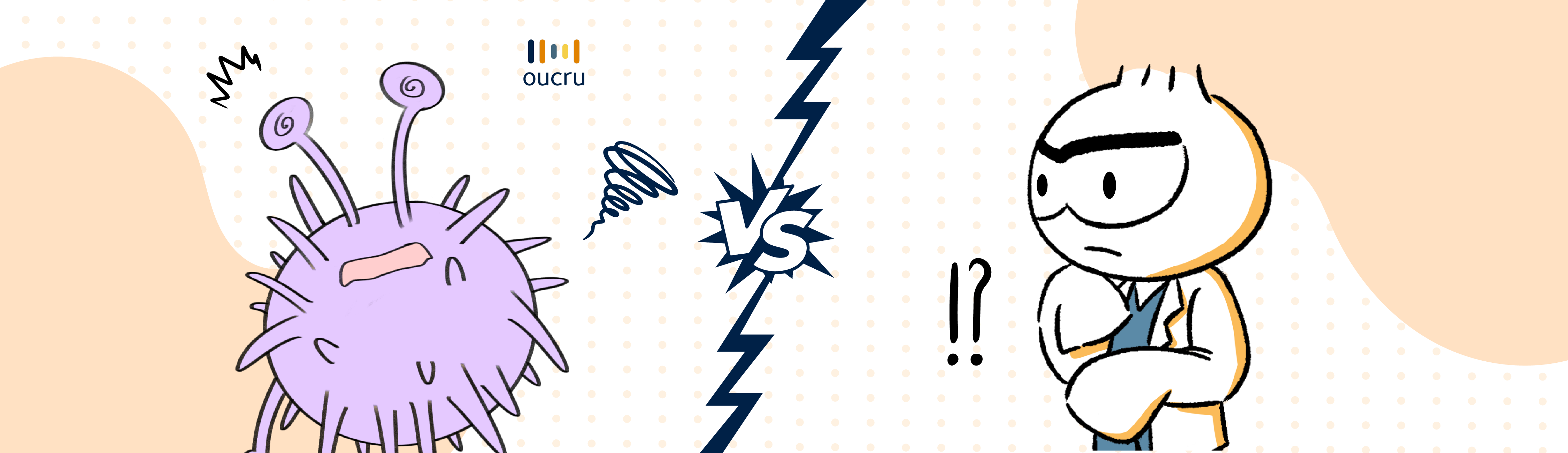
    Using the interesting perspective of a ‘keyboard battle’ between doctors and bacteria on an imaginary social media platform, Collab Lab’s video provides an easy-to-understand and visual approach, helping the public grasp the importance of antibiotic stewardship and rational antibiotic use.

    Watch this Collab Lab video on OUCRU’s public communications channels and at the Collab Lab project page.

    Reference:

    (*) https://vnexpress.net/nguy-co-khong-con-thuoc-chua-do-khang-khang-sinh-4530533.html

  • TBM survivor: “TBM can be completely cured.”

    TBM survivor: “TBM can be completely cured.”

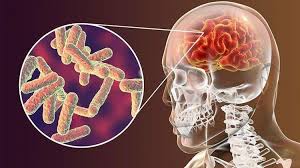
    Tuberculous meningitis (TBM) is a form of tuberculosis that carries the highest mortality rate due to its gradual onset, non-specific symptoms, and easy confusion with other brain infections. 

    The World Health Organization (WHO) estimates that children account for 10-12% of new and recurring TB cases annually. Approximately 70,000 infants and children die from TB each year(1)

    TBM represents 1-5% of total TB cases. While it can occur at any age, in children, TBM most commonly affects the age group 1 to 5, a time when their brains are still immature. Insults or infections of the brain at this time can have long lasting affects, such as disability. 

    In 2022, WHO made a conditional recommendation that a shorter 6-month intensive TB drug regimen with aspirin could be used an alternative to the standard 12-month treatment, based on a systematic review and meta-analysis of observational studies showing reduced mortality in children with TBM. This shortened regimen would potentially have large benefits for families and health systems. 
     
    In partnership with our international partners including Medical Research Council, University College London, Wellcome Trust, UKAID, and National Institute for Health and Care Research, OUCRU conducts a randomised controlled trial to evaluate whether this 6-month regimen is as effective and safe as the standard 12-month treatment for children with TBM between 29 days and 18 years of age. 

    TBM survivor quote

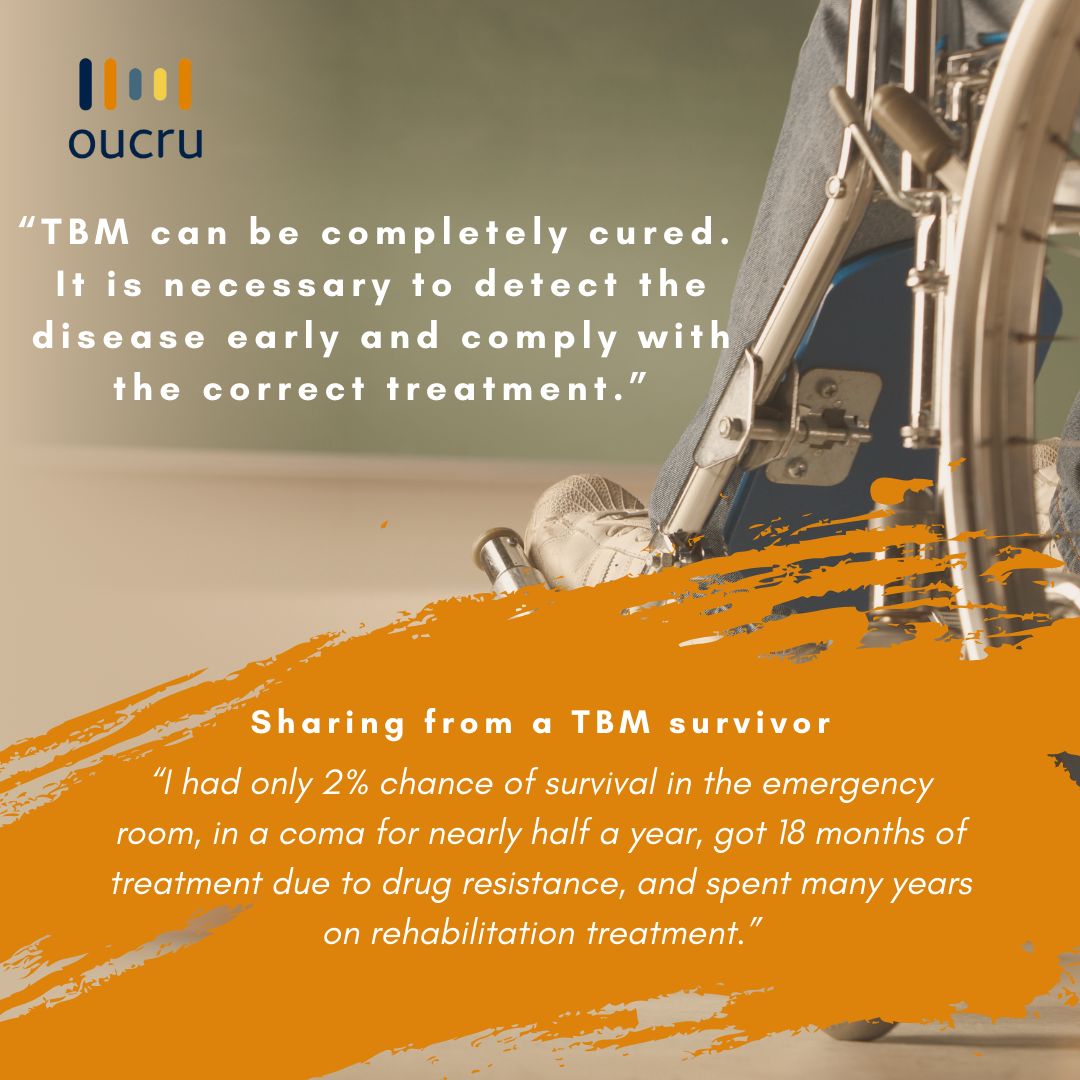
    “I have come back to life after I recovered from meningitis TB for more than 13 years ago. With only 2% chance of survival in the emergency room and I was in a coma for nearly half a year, I got 18 months of treatment due to drug resistance and I also spent many years after that to receive rehabilitation treatment and return to life. Although I have the sequelae that make me a person with a particularly severe disability, I am proud that I have done the job which is social work that I dreamed of since childhood, and I am currently a law student at Open University in Hanoi. I want to send the message to TB patients that: TB meningitis can be completely cured and TB drugs will not destroy the intelligence of who being treated, to recover and return to life effectively, it is necessary to detect the disease early and comply with the correct treatment to minimize the sequelae”.

    Working closely with TBM-affected children and their families revealed their unique challenge to the project team. This community’s needs overlap between multiple areas—clinical care, research, and policy programme—often resulting in gaps in comprehensive care. Using the World Health Organization (WHO) “Defeating Meningitis by 2030: global roadmap” as a framework, the SURE project team at OUCRU explored ways to better support children with TBM across five key areas: diagnosis and treatment, surveillance, support and care for affected people, and advocacy and engagement.

    Through this TBM research project, Dr Julie Huynh and the project team at OUCRU discovered that caregivers of children who are affected by TBM face several challenges including a lack of post-hospital discharge support systems and the financial, medical, and emotional burden of caring for their child who leaves hospital with disability. 

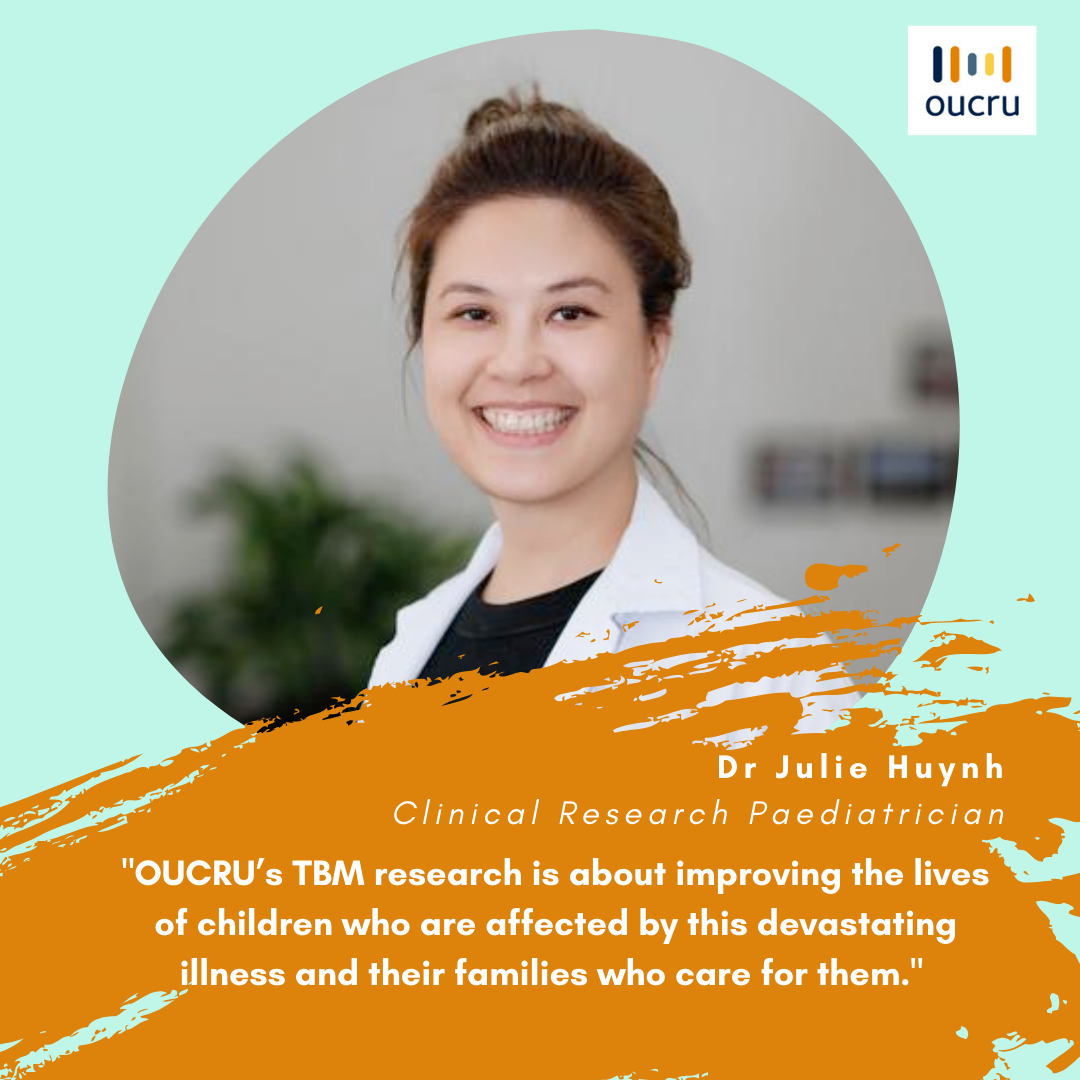
    “As a paediatrician, it is gut-wrenching to see young, previously healthy children die from TB meningitis, or live with some form of disability if they are fortunate to survive.  The first thing parents ask me when the diagnosis is given is ” Will my child be ok?  Will his/her brain be normal?  Will they be able to go to school and do the normal things children do?”.  This is what our research at OUCRU is about.  It’s about improving the lives of children who are affected by this devastating illness and their families who care for them”

    To address these challenges, Dr Julie Huynh collaborated with the Public and Community Engagement group to establish a community advisory board (CAB) consisting of 5 family members (parents/carers) of children who have survived TBM but with long lasting effects. The project team plans to gather insightful feedback from the board members, develop and pilot several support packages for TBM survivors’ families.  

    Given that most hospitalised cases are severe, difficult to diagnose, and often result in serious long-term consequences even after successful treatment, this community-based approach is particularly important in helping to lighten the burden on TBM survivors’ families and address the gap in institutional support. 

    A booklet of care instructions and rehabilitation guidelines 

    Beyond providing valuable insights, board community members collaborate with Dr Julie and the project team to co-design a visual booklet containing guidelines and care instructions for parents of children living with disability at home. The resource will receive technical oversight from Dr Julie and incorporate special contributions from a TBM survivor, combining professional expertise with practical, real-life experience. 

  • 60% bệnh nhân viêm gan C không biết mình nhiá»…m bệnh từ đâu (1)

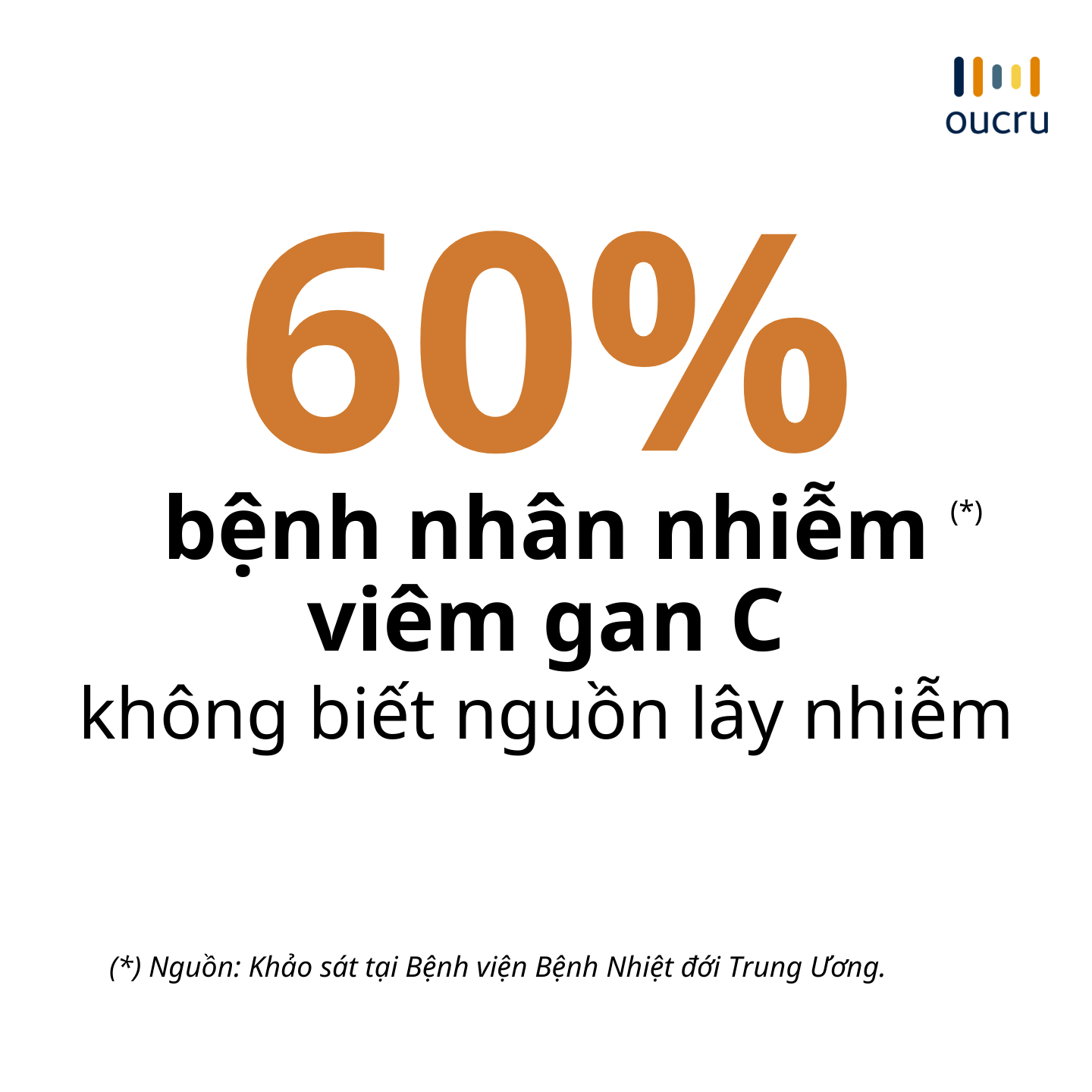
    60% bệnh nhân viêm gan C không biết mình nhiễm bệnh từ đâu (1)

    Một khảo sát tại Bệnh viện Bệnh Nhiệt đới Trung ương cho thấy khoảng 60% bệnh nhân không biết tại sao mình nhiễm viêm gan C và hầu hết bệnh nhân chỉ phát hiện bệnh khi đã ở giai đoạn muộn(1).

    Theo Tổ chức Y tế Thế giới (WHO), số ca tử vong do viêm gan siêu vi ngày càng tăng với khoảng 3.500 người mỗi ngày. Báo cáo được công bố tại Hội nghị Thượng đỉnh về Viêm gan Thế giới hồi tháng 4/2024 cho thấy viêm gan siêu vi là bệnh truyền nhiễm gây tử vong lớn thứ 2 thế giới, chỉ sau lao phổi, với 1,3 triệu người chết mỗi năm(2).

    Những con số này càng đáng lo ngại hơn khi đặt trong tình huống việc ngăn ngừa viêm gan đã có những tiến bộ vượt bậc về khoa học và quản lý y tế: giá thuốc giảm, công cụ chẩn đoán và chữa bệnh tốt, nhiều quốc gia trong đó có Việt Nam có chính sách bảo hiểm y tế phù hợp cho người bệnh.

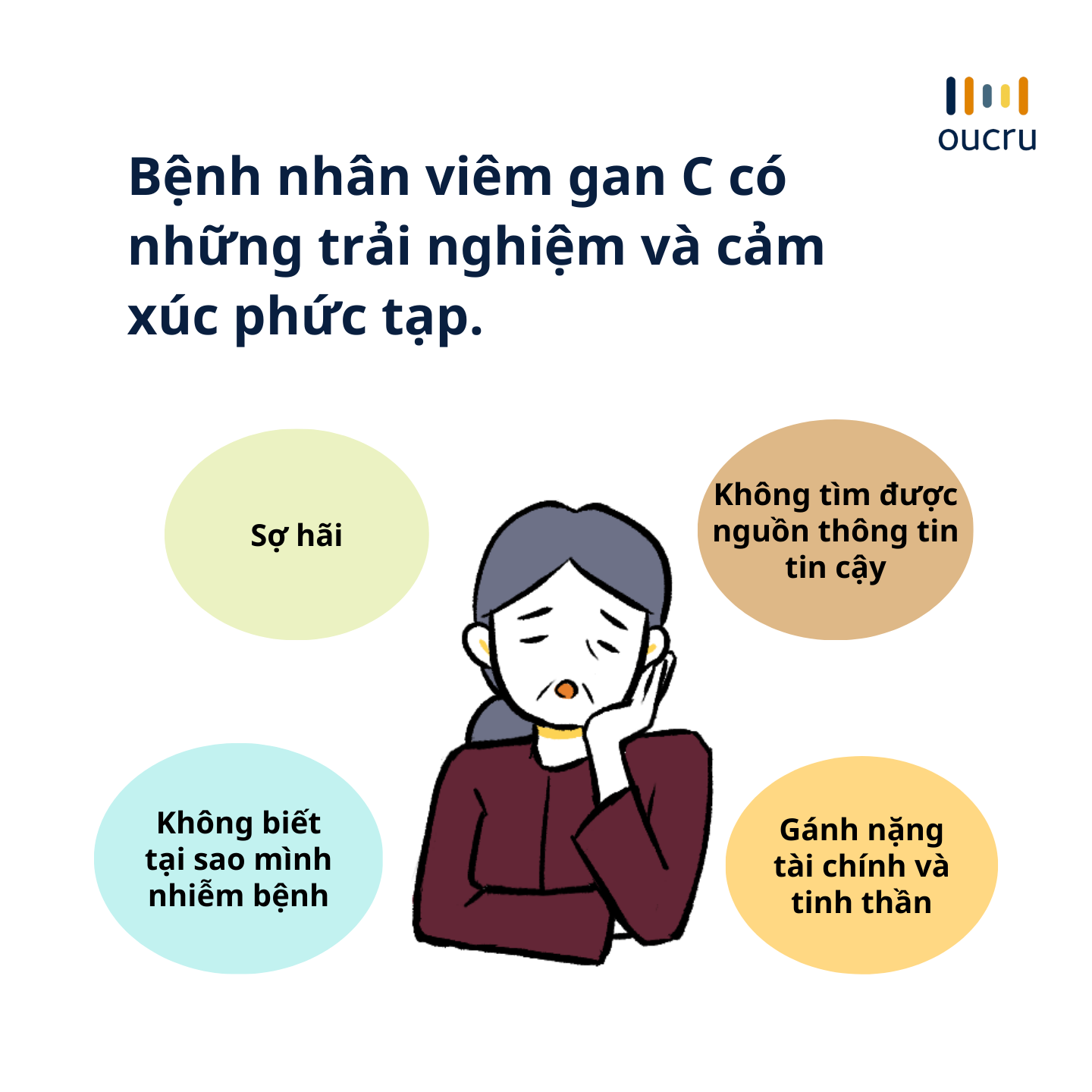
    Để tìm hiểu những yếu tố văn hóa, xã hội, và tâm lý đang ảnh hưởng đến quá trình chẩn đoán, tiếp cận và duy trì điều trị của bệnh nhân Viêm Gan C, phòng Nghiên cứu Khoa học xã hội và Nghiên cứu ứng dụng của OUCRU đã tiến hành một nghiên cứu trên các bệnh nhân đang thăm khám và điều trị viêm gan C tại Bệnh Viện Bệnh Nhiệt Đới.

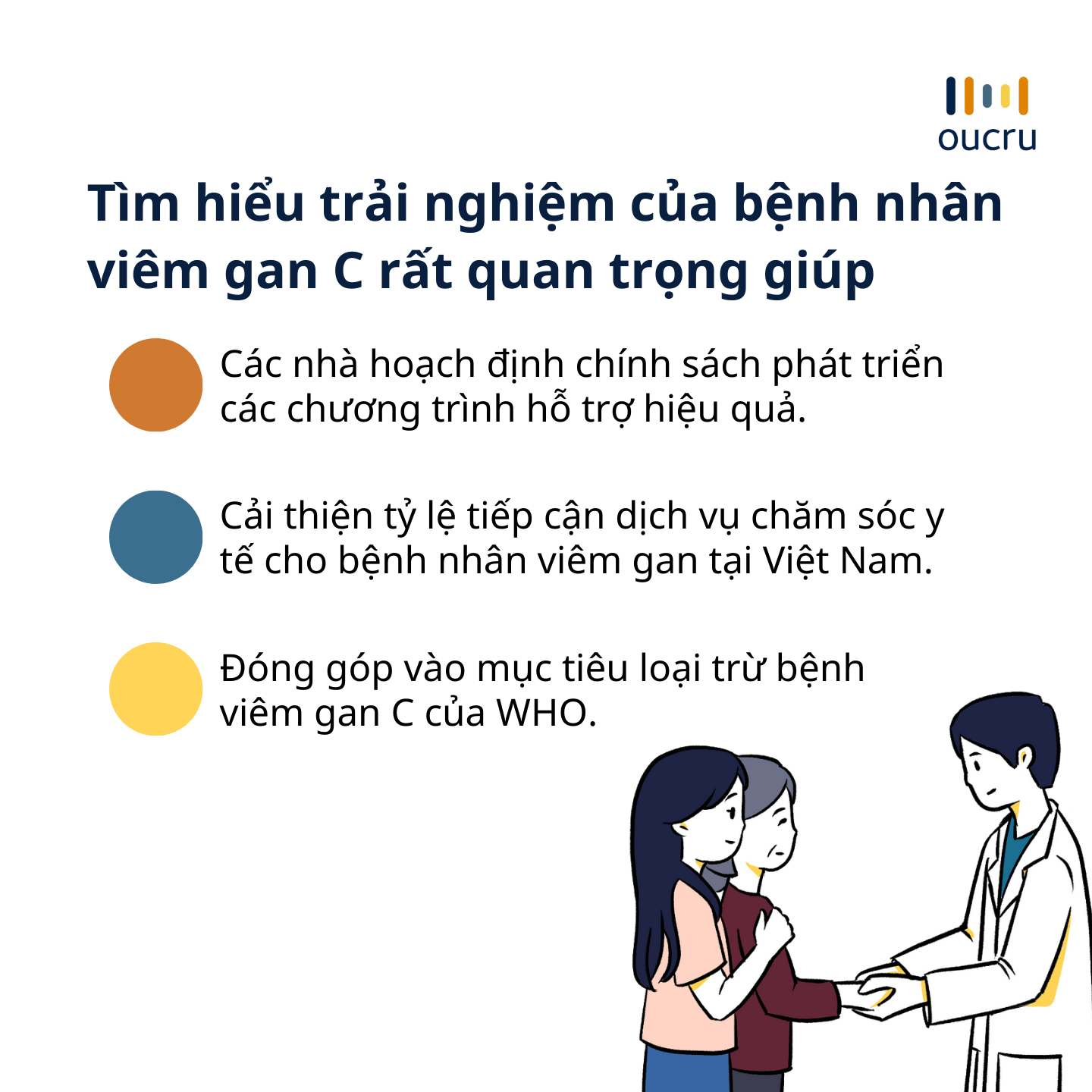
    Kết quả của nghiên cứu đã chỉ ra những đặc trưng tâm lý của bệnh nhân và thân nhân người bệnh có thể ảnh hưởng đến việc tìm kiếm chăm sóc và điều trị viêm gan C trong bối cảnh Việt Nam. Nghiên cứu cũng đóng vai trò kết nối giữa bệnh nhân và các nhà hoạch định chính sách, từ đó góp phần giúp phát triển và cải thiện các chương trình y tế công cộng tại Việt Nam, hướng đến mục tiêu của Tổ chức Y tế Thế giới là loại bỏ virus viêm gan như một mối đe dọa sức khỏe cộng đồng vào năm 2030.

    Xem thông tin của nghiên cứu trong infographic bên dưới và đón xem video tóm tắt do đội ngũ thanh niên trẻ của Collab Lab sản xuất.

    (*) Collab Lab là sáng kiến của các Đại sứ Kết Nối Khoa học (Youth Science Ambassadors) OUCRU, với mục tiêu trang bị cho người trẻ những kỹ năng và kiến thức cần thiết để hỗ trợ và thực hiện các dự án kết nối khoa học với công chúng và cộng đồng. Các thành viên của Collab Lab đến từ nhiều trường đại học đã tóm tắt và hoạt hình hóa các nghiên cứu liên quan đến các vấn đề sức khỏe toàn cầu. Các video của Collab Lab sử dụng hình ảnh vui nhộn, nội dung dễ hiểu, sử dụng ngôn từ gần gũi với giới trẻ để đưa các chủ đề khoa học phức tạp đến gần hơn với nhóm người xem không thuộc giới học thuật. Collab Lab còn đóng vai trò cầu nối, giúp các nhà khoa học thu thập đóng góp và phản hồi từ công chúng, đặc biệt là người trẻ, cho các chủ đề nghiên cứu.

    Xem toàn bộ video do Collab Lab thực hiện

    Tài liệu tham khảo:

    (1) https://vnexpress.net/viem-gan-c-sat-thu-tham-lang-co-the-chua-khoi-4760745.html

    (2) https://vnexpress.net/who-canh-bao-ganh-nang-viem-gan-sieu-vi-toan-cau-4747161.html

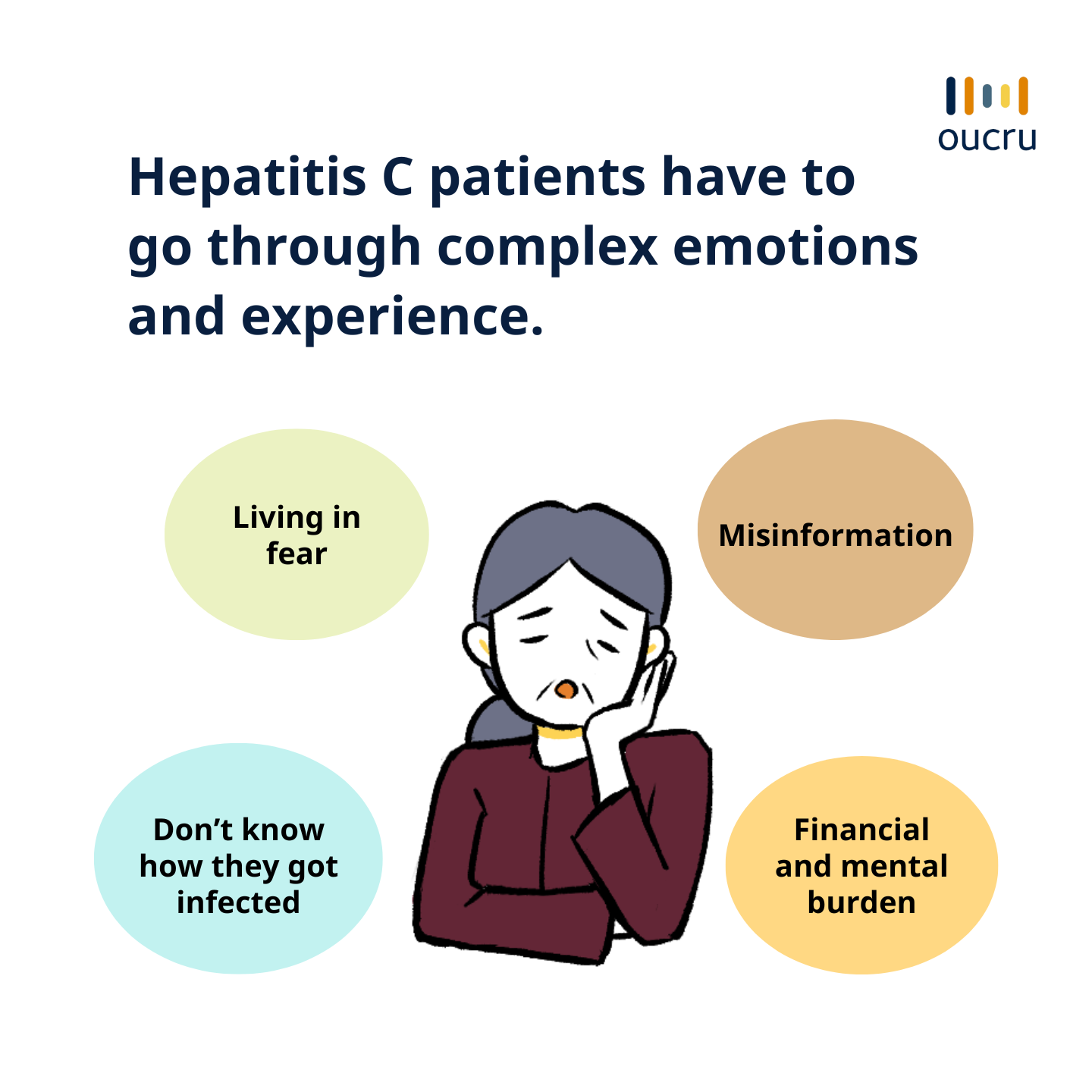
  • 60% of hepatitis C patients do not know how they had the disease(1)

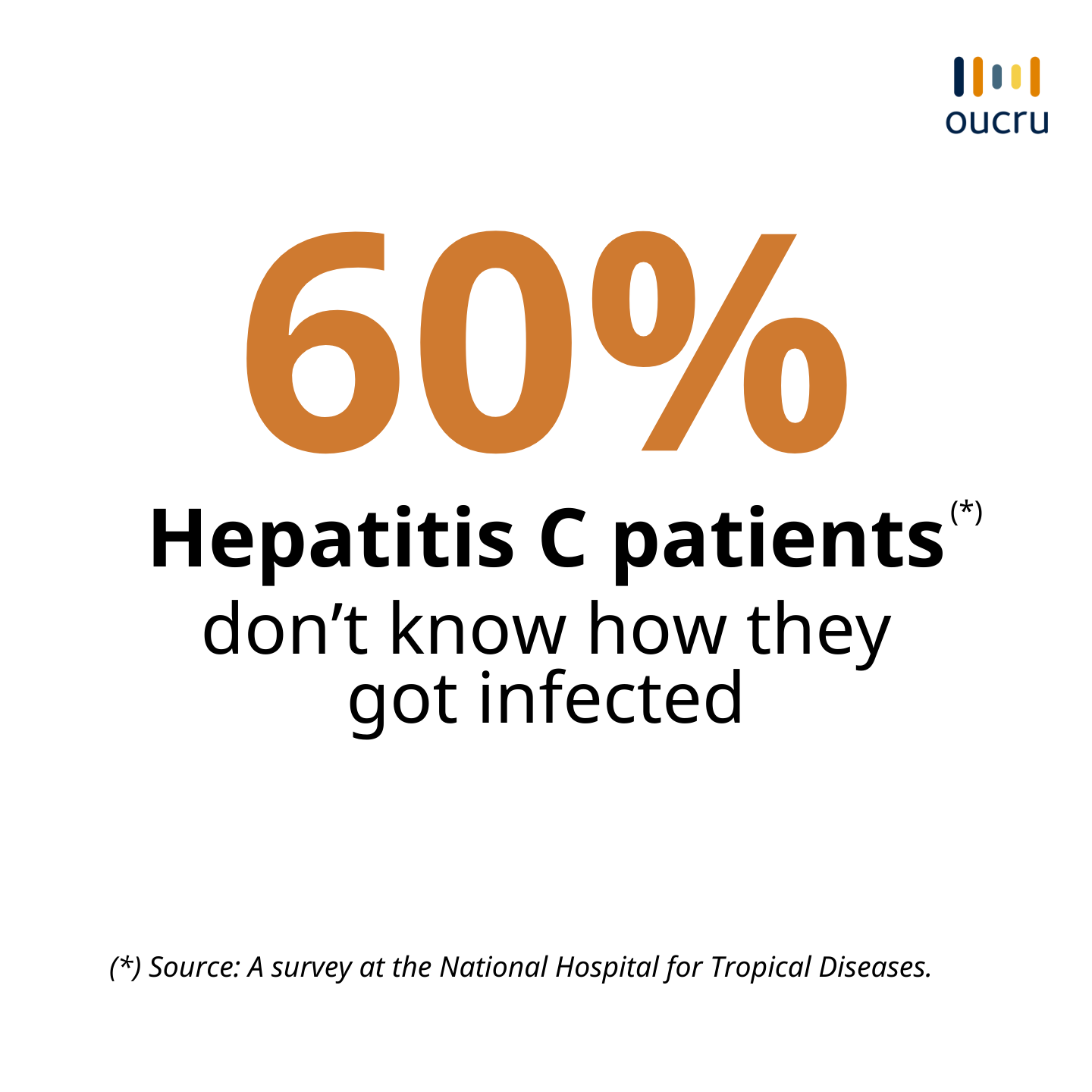
    60% of hepatitis C patients do not know how they had the disease(1)

    A survey conducted at the National Hospital for Tropical Diseases shows that approximately 60% of patients did not know how they contracted hepatitis C and the majority of patients only discovered their disease when it had been already in the late stage(1).

    The World Health Organization (WHO) estimates that the number of deaths caused by viral hepatitis is increasing with a projected 3,500 daily deaths. According to a report presented at the World Hepatitis Summit in April 2024, viral hepatitis is the second biggest infectious killer disease after tuberculosis with 1.3 million deaths each year(2).

    These figures become even more threatening in the context of current medical advancement in treating hepatitis and public health management: more affordable cost of treatment, better diagnostic and therapeutic facilities, and most countries including Vietnam included hepatitis treatment under public health insurance policies.

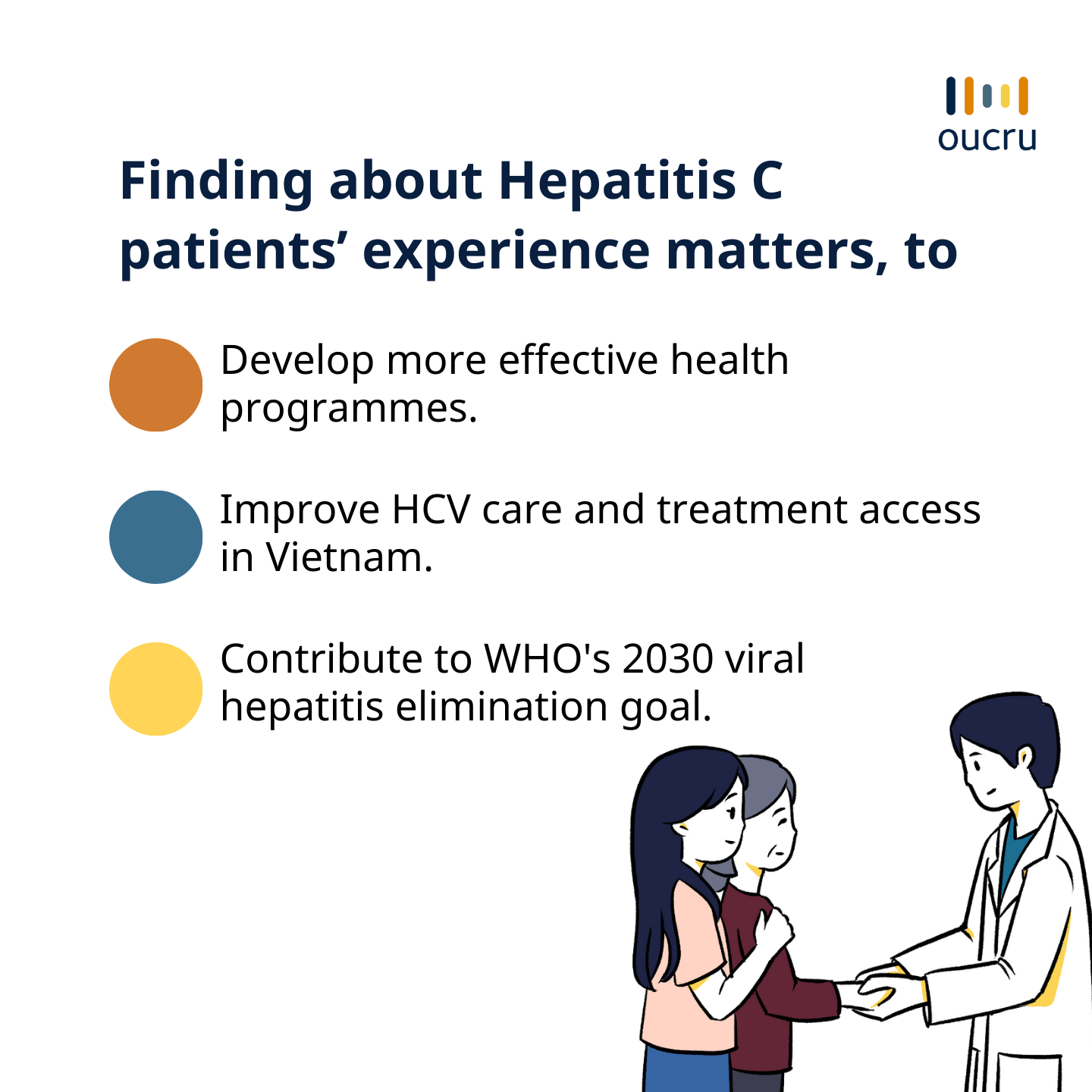
    In order to identify the cultural, social, and psychological determinants affecting the diagnosis, access, and treatment compliance of Hepatitis C patients, OUCRU’s Social Science and Implementation Research group conducted a study among patients who were being examined and treated for Hepatitis C at the Hospital for Tropical Diseases.

    The study findings identified psychological characteristics of patients and carers that can influence their journey for treatment and care for hepatitis C in the Vietnamese context. The study is also served as a bridge between the patients and policymakers, thus promoting the design and quality of public health programmes in Vietnam towards the achievement of the WHO goal to eliminate the hepatitis virus as a public health issue by 2030.

    Check out the summarised research findings in the infographic below and stay tuned for the full video from Collab Lab.

    (*) Collab Lab is a project by OUCRU’s Youth Science Ambassadors (YSAs) to equip youth with the skills and knowledge required for public engagement in health science. The team selects and summarizes published literature on global health issues, which they then animate. Collab Lab’s videos are fun to watch, using cute drawings and modern slangs to explain complex scientific topics in a way non-science audiences can easy to understand. Collab Lab also serves as a bridge, helping scientists gain valuable information from the public, especially from young population.

    Watch full Collab Lab playlist here.

    References:

    (1) https://vnexpress.net/viem-gan-c-sat-thu-tham-lang-co-the-chua-khoi-4760745.html

    (2) https://vnexpress.net/who-canh-bao-ganh-nang-viem-gan-sieu-vi-toan-cau-4747161.html

  • Sorotan 2024: Engagement Berkelanjutan bersama Anak Muda dalam Penelitian di OUCRU

    Sorotan 2024: Engagement Berkelanjutan bersama Anak Muda dalam Penelitian di OUCRU

    Saksikan ulang momen terbaik dari Public and Community Engagement.
    Berkolaborasi dengan anak muda, kami berkomitmen menjaga koneksi yang kuat antara penelitian dan generasi muda melalui berbagai kegiatan di seluruh site.

    Partisipasi Aktif Kaum Muda dalam Penelitian

    Sebagai bagian dari SEACOVARIANTS—sebuah proyek penelitian multidisiplin yang menilai signifikansi biologis varian SARS-CoV-2 guna mendukung pembuat kebijakan berbasis bukti—Youth Action Research Group di Kota Ho Chi Minh telah menjadi bagian utama dari upaya mendengar masyarakat yang terdampak krisis kesehatan.

    Inisiatif ini mengumpulkan anak-anak muda yang antusias dan berdaya melalui pelatihan dan kegiatan praktek untuk berpartisipasi aktif dalam penelitian dan berkontribusi menuangkan perspektif unik mereka. Saat ini kelompok ini mengembangkan kerangka keterlibatan kesiapsiagaan wabah yang berguna membantu mengidentifikasi kelompok yang sulit dijangkau dan terkena dampak besar selama wabah. Mereka juga terlibat dalam menginformasikan rekomendasi untuk meningkatkan kebijakan kesehatan masyarakat selama krisis kesehatan di masa depan.

    Peluang untuk Peneliti Muda

    Proyek Seed Awards telah menjadi titik fokus mempromosikan keterlibatan masyarakat di antara para peneliti muda OUCRU selama 5 tahun terakhir. Dengan menyediakan pendanaan dan dukungan untuk proyek penelitian yang digerakkan oleh masyarakat, kami mendorong para peneliti muda untuk mengembangkan engagement, menumbuhkan kreativitas dan inovasi serta meningkatkan koneksi antara akademisi dan komunitas yang lebih luas.

    Jelajahi lebih banyak proyek keterlibatan yang didanai oleh Seed Awards di sini.

    Membina Advokat Masa Depan

    Anak Melawan AMR di Nepal

    OUCRU Nepal merayakan Pekan Kesadaran Resistensi Antimikroba (AMR) Dunia (WAAW) sejak 2016. Sebagai bagian dari misi kami untuk memberikan informasi, berinteraksi dan melibatkan masyarakat tentang masalah AMR, tim keterlibatan publik (PE) melakukan berbagai kegiatan untuk WAAW 2024. Dengan tema “Educate, Advocate, Act now”, kami meluncurkan kampanye keterlibatan pemuda komprehensif yang menampilkan kegiatan inovatif, kreatif, dan partisipatif di seluruh platform digital maupun tatap muka. Melalui penceritaan visual dan diskusi, tim kami bekerja untuk meningkatkan kesadaran tentang AMR, mempromosikan penggunaan antibiotik yang bertanggung jawab, dan mendorong kolaborasi lintas sektor. Berikut adalah sorotan utama dari kampanye kami:

    • Lebih dari 120 siswa dari tiga sekolah berpartisipasi dalam sesi “Memerangi AMR dengan Pemuda”.
    • 21 vlog kreatif diproduksi untuk mengeksplorasi perilaku pencari layanan kesehatan.
    • “Paint down the bugs,” adalah workshop pembuatan komik selama dua hari, mempertemukan 8 seniman muda untuk menciptakan empat cerita mengenai topik kompleksitas konsep AMR.
    • 46 profesional muda dari Teknologi Informasi, farmasi, teknik, kedokteran, dan manajemen menghadiri webinar kolaboratif kami “The AMR Chronicles: Battling the Invisible Enemy.”
    Tonton daftar putar lengkapnya di sini.

    Meningkatkan Kesadaran di Kalangan Anak Muda Indonesia

    Di Indonesia, banyak orang menggunakan antibiotik sebagai obat umum setiap kali mereka sakit. Dengan dukungan OUCRU, CIMSA (Pusat Kegiatan Mahasiswa Kedokteran Indonesia) membuat serangkaian video eksperimen sosial berdurasi 3 menit. Kelompok mahasiwa ini mewawancarai kaum muda dan masyarakat umum mengenai penggunaan dan pengetahuan antibiotik secara general. Temuan ini menujukkan: 8 dari 10 orang tidak mengerti dengan istilah AMR, dan setengahnya menggunakan antibiotik untuk infeksi sederhana tanpa diagnosis yang tepat. Tim CIMSA dan OUCRU menggabungkan komentar ahli dari Dr. Robert Sinto untuk memberikan konteks ilmiah untuk penjelasan dan saran lebih lanjut.

    Selama inisiatif World AMR Awareness Week 2024 ini, mahasiswa CIMSA memperoleh pengalaman berharga dalam melakukan wawancara penelitian dan membuat video edukasi. Kegiatan ini selaras dengan misi kami, meningkatkan literasi ilmiah dan membangun kapasitas di kalangan anak muda dan generasi mendatang.

    Tonton daftar putar lengkapnya di sini.

    Membuat Sains Masuk Akal: Teater Sains dan Pameran

    Kelompok Public and Community Engagement OUCRU meluncurkan tur teater sains di sekolah menengah Kota Ho Chi Minh untuk meningkatkan kesadaran AMR. Drama interaktif “Minum Obat Sembarang, Bakteri Bisa Resisten” menggunakan humor dan elemen ramah Gen Z untuk mengajarkan siswa tentang penggunaan antibiotik yang tepat, berhasil menjangkau dan terlibat dengan 5.000 siswa.

    Membangun kesuksesan drama AMR, kelompok Keterlibatan Publik dan Komunitas OUCRU bermitra dengan Departemen Pendidikan Tien Giang untuk menyelenggarakan acara sains, termasuk drama komunitas dan pameran sains. Acara ini memberi siswa ruang untuk menunjukkan pemahaman ilmih dan menunjukkan bagaimana seni dapat membuat topik yang kompleks dapat dimengerti.

    Selain merayakan pencapaian siswa dan guru Tien Giang, acara ini bertujuan untuk menginspirasi sekolah lain untuk merangkul pendidikan sains dan mendorong anak-anak kecil untuk berpikir kritis tentang masalah kesehatan di masa depan.

    Menerapkan metode Teater Forum untuk meningkatkan kesadaran tentang Tetanus, dipimpin dan dilaksanakan oleh Youth Science Ambassador.

    Diluncurkan pada tahun 2024, Youth Science Ambassadors (YSA) adalah program pemberdayaan pemuda berusia 18 hingga 25 tahun di universitas di Kota Ho Chi Minh. Para pemuda berkolaborasi OUCRU secara sukarela selama 1 tahun untuk berpartisipasi dalam sesi pelatihan dan pendampingan tentang keterlibatan publik sambil merencanakan dan melaksanakan inisiatif secara mandiri.

    Dari survei singkat tentang kebutuhan untuk mempelajari lebih lanjut tentang 10 penyakit menular teratas di kalangan anak muda, tetanus berada di urutan kedua dari terakhir, hasil ini cukup mengkhawatirkan karena beberapa anak muda di Vietnam tidak divaksinasi.

    Menyadari situasi ini membutuhkan lebih banyak kesadaran publik tentang bahaya tetanus dan mendorong semua orang untuk divaksinasi, YSA 2024 memutuskan untuk membuat proyek Protect Us from Tetanus (PUFT) yang menampilkan Pembicaraan Kesehatan Rumah Sakit untuk pasien dan pengasuh serta Pertunjukan Teater Forum untuk kaum muda dan masyarakat luas.

    Teater forum, metode interaktif yang menyediakan platform bagi penonton untuk campur tangan dan mengubah adegan, sehingga mengubah konsekuensi dari cerita yang berakhir dengan catatan negatif, telah dipilih dengan tujuan agar pendekatan yang menarik ini akan membantu mendorong lebih banyak anak muda untuk berpartisipasi aktif dalam kegiatan tersebut. Acara tersebut dilakukan secara langsung dengan drama, tanpa menggunakan naskah tentang perjalanan terkena infeksi tetanus di 4 sekolah Kota Ho Chi Minh. Skenario yang dipimpin komunitas didigitalkan untuk pengunjung yang tidak dapat bergabung dengan sesi di tempat.

    Science Visit

    Sejak tahun 2017, Science Visits telah berperan sebagai jembatan yang menghubungkan anak-anak yang memiliki rasa ingin tahu yang tinggi dengan penelitian ilmiah melalui pengalaman yang menarik. Dalam kunjungan ini, para peserta muda mengikuti tur berpemandu ke laboratorium mutakhir, berinteraksi langsung dengan para ilmuwan, mengamati para peneliti yang sedang bekerja, dan berpartisipasi dalam kegiatan bermain peran yang interaktif. Setelah sempat terhenti sejenak selama pandemi COVID-19, Science Visits kini telah kembali – dengan memperluas cakupannya di luar siswa sekolah hingga mencakup mahasiswa, terutama mereka yang mempelajari sains. Pada tahun 2024, kami menyelenggarakan 6 tur, menyambut lebih dari 120 peserta, termasuk siswa dan guru dengan umpan balik yang positif.

    Tahun 2025 akan menjadi tahun di mana kami akan terus memperkuat hubungan antara penelitian OUCRU dan komunitas lokal, membina generasi masa depan, dan meningkatkan pemahaman dan kesadaran publik tentang masalah kesehatan global. Kami berharap dapat berkontribusi untuk membangun masyarakat berbasis bukti ilmiah dengan tujuan meningkatkan kualitas hidup melalui penelitian.

  • Kết nối khoa học vá»›i công chúng và cá»™ng đồng: Tăng cường sá»± tham gia cá»§a người trẻ trong Nghiên cứu 

    Kết nối khoa học với công chúng và cộng đồng: Tăng cường sự tham gia của người trẻ trong Nghiên cứu 

    Kết nối khoa học vá»›i công chúng và các cá»™ng đồng có liên quan vào nghiên cứu là má»™t phần không thể tách rời trên hành trình thá»±c hiện sứ mệnh cá»§a OUCRU: thá»±c hiện các nghiên cứu tại địa phương vá»›i tác động toàn cầu. Cùng nhìn lại những thành tá»±u trong năm 2024 cá»§a OUCRU trong lÄ©nh vá»±c này, đặc biệt là những dấu mốc về mối quan hệ hợp tác ngày má»™t phát triển và có ý nghÄ©a giữa nghiên cứu và các bạn trẻ.  

    Giá»›i trẻ có những đóng góp tích cá»±c trong nghiên cứu 

    Nhóm Thanh niên Nghiên cứu Hành động (Youth Action Research Group – YARG) 

    Là một phần của dự án Sáng kiến ứng phó với các biến chủng mới của SARS-CoV-2 tại khu vực Đông Nam Á (SEACOVARIANTS), một dự án nghiên cứu đa ngành đánh giá nhanh nguy cơ tiềm tàng về khía cạnh sinh học của các biến thể SARS-CoV-2, từ đó, cung cấp thông tin nhanh chóng kịp thời hỗ trợ các nhà hoạch định chính sách địa phương trong việc đưa ra quyết định dựa trên chứng cứ thu được.  

    Nhóm YARG đã đóng vai trò quan trọng trong việc há»— trợ các nhà khoa học xác định các cá»™ng đồng bị ảnh hưởng trong các cuá»™c khá»§ng hoảng y tế như đại dịch COVID-19, cÅ©ng như thu thập ý kiến và đề xuất cá»§a nhóm cá»™ng đồng này. Nhóm Ä‘ang xây dá»±ng má»™t khung làm việc giúp xác định các nhóm khó tiếp cận và bị ảnh hưởng nặng nề trong đại dịch cÅ©ng như đưa ra các khuyến nghị để cải thiện chính sách y tế công cá»™ng trong các cuá»™c khá»§ng hoảng y tế trong tương lai. 

    Tập hợp các bạn trẻ nhiệt huyết, nhóm YARG đã và Ä‘ang được trao quyền để tích cá»±c tham gia và đưa vào nghiên cứu những đóng góp có giá trị dưới góc nhìn cá»§a người trẻ.  

    Khuyến khích nhà khoa học trẻ kết nối với công chúng và cộng đồng

    Trong 9 năm qua, dự án Giải thưởng Hạt giống đã trở thành công cụ đắc lực hỗ trợ nhiều nhà khoa học trẻ thực hiện các dự án kết nối khoa học với công chúng và cộng đồng, truyền cảm hứng sáng tạo và đổi mới cũng như xây dựng và nuôi dưỡng mối liên kết ngày càng chặt chẽ và vững mạnh giữa các nhà nghiên cứu và cộng đồng cũng như công chúng.  

    Nuôi dưỡng cộng đồng ủng hộ khoa học nhiệt thành trong tương lai  

    ‘Thanh niên Chống Kháng kháng sinh’ tại Nepal   

    Nâng cao nhận thức về Kháng Kháng Sinh đã trở thành hoạt động thường niên tại OUCRU Nepal trong nhiều năm qua, đặc biệt là trong tuần lễ đặc biệt về chủ đề này do WHO khởi xướng (18 – 24 tháng 11 hàng năm). Trong năm 2024, OUCRU Nepal đã chọn các bạn học sinh là nhóm đối tượng chính cho các hoạt động tương tác vui nhộn của mình nhằm hưởng ứng chủ đề năm nay ‘Giáo dục. Vận động. Hành động.’ Bên cạnh các buổi chia sẻ và thảo luận tương tác với nhà khoa học tại trường, hàng trăm học sinh còn tham gia khóa học vẽ truyện tranh và thi tài sáng tạo mini-vblog. Cùng nhìn lại những con số ấn tượng của năm 2024 từ OUCRU Nepal:  

    • 120 học sinh tham gia các phiên chuyên đề về kháng kháng sinh.  
    • 21 mini-vblog đã được sản xuất nhằm tìm hiểu thói quen liên quan đến sức khỏe cá»§a người dân.  
    • Buổi học vẽ truyện tranh 2 ngày ‘Thá»­ tài vẽ bọ’ thu hút 8 nghệ sÄ© cá»§a Nepal tham gia sáng tạo các mẩu truyện tranh vá»›i thông Ä‘iệp dá»… hiểu nhằm giúp truyền thông đến mọi người dá»… dàng hÆ¡n.  
    • Há»™i thảo ‘Biên niên sá»­ Kháng Kháng Sinh: Cuá»™c chiến chống lại kẻ thù vô hình’ vá»›i sá»± tham gia cá»§a 46 các bạn trẻ đến từ nhiều ngành nghề khác nhau như IT, y, dược, kỹ sư, quản trị v.v..  

    Loạt video nâng cao nhận thức cộng đồng do tổ chức sinh viên y khoa tại Indonesia thực hiện 

    Cũng tập trung vào việc nâng cao nhận thức của nhóm người trẻ, Phòng Kết nối Khoa học với Công chúng (PCE) tại OUCRU Indonesia đã thực hiện một cuộc thí nghiệm xã hội, phỏng vấn nhanh nhiều người khác nhau thuộc đa dạng các nhóm tuổi và ngành nghề, nhằm tìm hiểu về mức độ hiểu biết thuốc kháng sinh, thói quen sử dụng, cũng như chia sẻ lời khuyên từ chuyên gia, Bác sĩ Robert Sinto.  

    Tại Indonesia, nhiều người sá»­ dụng kháng sinh không đúng mục đích bất cứ khi nào họ cảm thấy không khỏe trong người. Thí nghiệm xã há»™i dài 3 phút này do Trung tâm Hoạt động Sinh viên Y khoa Indonesia (Center for Indonesian Medical Students’ Activities – CIMSA) phối hợp thá»±c hiện cùng OUCRU. Kết quả không quá bất ngờ nhưng vẫn rất báo động: 8 trong số 10 người tham gia phỏng vấn không biết gì về kháng kháng sinh và phân ná»­a thừa nhận có sá»­ dụng kháng sinh dù không Ä‘i khám bác sÄ©.

    Hoạt động thí nghiệm xã há»™i này đánh dấu lần đầu tiên hợp tác giữa phòng Kết Nối Khoa học vá»›i Công chúng và Cá»™ng đồng, OUCRU ID và CIMSA; góp phần giúp các bạn sinh viên được thá»±c hành kỹ năng phỏng vấn trong nghiên cứu và sản xuất các video cung cấp thông tin giáo dục. Đây cÅ©ng là má»™t trong những mục tiêu chính cá»§a phòng PCE – nâng cao mức độ hiểu biết và tin tưởng vào khoa học trong công chúng cÅ©ng như bồi dưỡng kỹ năng trong khoa học nói chung cho thế hệ tương lai.  

    Há»™i chợ Khoa học cổ vÅ© tinh thần sáng tạo cá»§a học sinh và giáo viên tại Tiền Giang   

    Tiếp nối thành công cá»§a vở kịch tương tác vui nhá»™n “Dùng thuốc linh tinh, có ngày kháng kháng sinh’, đã thu hút hÆ¡n 5.000 học sinh tại các trường trung học cÆ¡ sở ở TP.HCM đầu năm 2024, phòng PCE tiếp tục hợp tác vá»›i Sở Giáo dục Tiền Giang tổ chức chuá»—i sá»± kiện khoa học nhằm tạo sân chÆ¡i sáng tạo cho các em và thầy cô giáo.  

    Bên cạnh há»™i chợ vá»›i sá»± tham gia cá»§a hÆ¡n 500 học sinh và thầy cô, nhóm dá»± án Making Science Make Sense cÅ©ng đã tổ chức các buổi tập huấn, hướng dẫn kỹ năng viết kịch bản kịch, sáng tạo đạo cụ khoa học trá»±c quan v.v.. Các nhà khoa học nhí đã có các buổi trình diá»…n khoa học hấp dẫn cÅ©ng như thành công tạo nên các trò chÆ¡i khoa học vui nhá»™n bằng các vật liệu tái chế thân thiện vá»›i môi trường, truyền tải thành công thông Ä‘iệp sá»­ dụng thuốc đúng cách để phòng tránh kháng kháng sinh.  

    Kịch diá»…n đàn tương tác để ‘uốn’ Uốn Ván  

    Trong má»™t khảo sát nhanh về nhu cầu tìm hiểu kiến thức về 10 bệnh truyền nhiá»…m hàng đầu tại Việt Nam, uốn ván bất ngờ đứng vị trí áp chót. Kết quả này đáng báo động khi uốn ván là má»™t căn bệnh nghiêm trọng, dá»… để lại nhiều di chứng nặng nề và tình trạng tiêm phòng uốn ván ở Việt nam chưa được xem trọng.  

    Từ kết quả này, nhóm Đại sứ Kết nối Khoa học (Youth Science Ambassadors, YSA), sáng kiến trao quyền cho người trẻ tham gia phát triển và dẫn dắt các sáng kiến sức khỏe cộng đồng từ năm 2021, đã cùng nhau lên kế hoạch và thực hiện dự án Uốn Uốn Ván. 

    Dá»± án này nhằm mục đích nâng cao nhận thức cá»§a công chúng về mức độ nguy hiểm và nguy cÆ¡ trở nặng cao cá»§a uốn ván khi người nhiá»…m chưa được tiêm phòng cÅ©ng như khuyến khích người dân Ä‘i tiêm vắc-xin uốn ván. Dá»± án tập trung tác động vào nhóm bệnh nhân và người thân tại bệnh viện cÅ©ng như các bạn trẻ tại các trường đại học tại TP.HCM.  

    Điểm nổi bật của Uốn Uốn Ván là hình thức sân khấu diễn đàn, loại hình kịch tương tác sáng tạo giúp các khán giả có thể can thiệp và thay đổi kịch bản, từ đó thay đổi kết cục câu chuyện. Nhóm YSA đã chọn sân khấu diễn đàn để có thể tiếp cận dễ dàng hơn với các bạn sinh viên, khuyến khích các bạn sáng tạo và tương tác, từ đó hiểu sâu hơn về thông điệp của vở kịch nói riêng và dự án nói chung.  

    Bên cạnh hình thức tương tác trá»±c tiếp, nhóm PCE cÅ©ng sẽ số hóa vở kịch này để bất cứ ai cÅ©ng có thể cùng tương tác nếu không thể tham gia các buổi diá»…n trá»±c tiếp.  

    Tham quan Khoa học 

    Tá»± hào là má»™t trong những đơn vị nghiên cứu lâm sàng có phòng thí nghiệm hàng đầu khu vá»±c, từ năm 2017, OUCRU vui mừng được đón tiếp hàng trăm các em học sinh tham quan, quan sát trá»±c tiếp công việc cá»§a các nhà nghiên cứu, và hỏi đáp vá»›i nhà khoa học. 

    Năm 2024, trở lại sau má»™t thời gian ngắn tạm ngưng do COVID-19, dá»± án Tham quan Khoa học mở rá»™ng cá»­a đón chào nhiều đối tượng hÆ¡n, từ học sinh phổ thông đến sinh viên đại học. HÆ¡n 120 bạn trẻ đã tham gia 6 chuyến tham quan cùng các hoạt động thú vị khác trong dá»± án.  

    Tiếp nối các Ä‘iểm sáng cá»§a 2024, OUCRU trong 2025 vẫn sẽ tiếp tục cá»§ng cố mối quan hệ giữa các nghiên cứu cá»§a OUCRU và các cá»™ng đồng địa phương, nuôi dưỡng các thế hệ tương lai, và cải thiện mức độ nhận thức và hiểu biết về khoa học cá»§a công chúng đối vá»›i các vấn đề sức khỏe toàn cầu. Chúng tôi luôn ná»— lá»±c đóng góp vào mục tiêu cá»§a xã há»™i: nâng cao chất lượng cuá»™c sống thông qua các nghiên cứu khoa học dá»±a vào bằng chứng.  

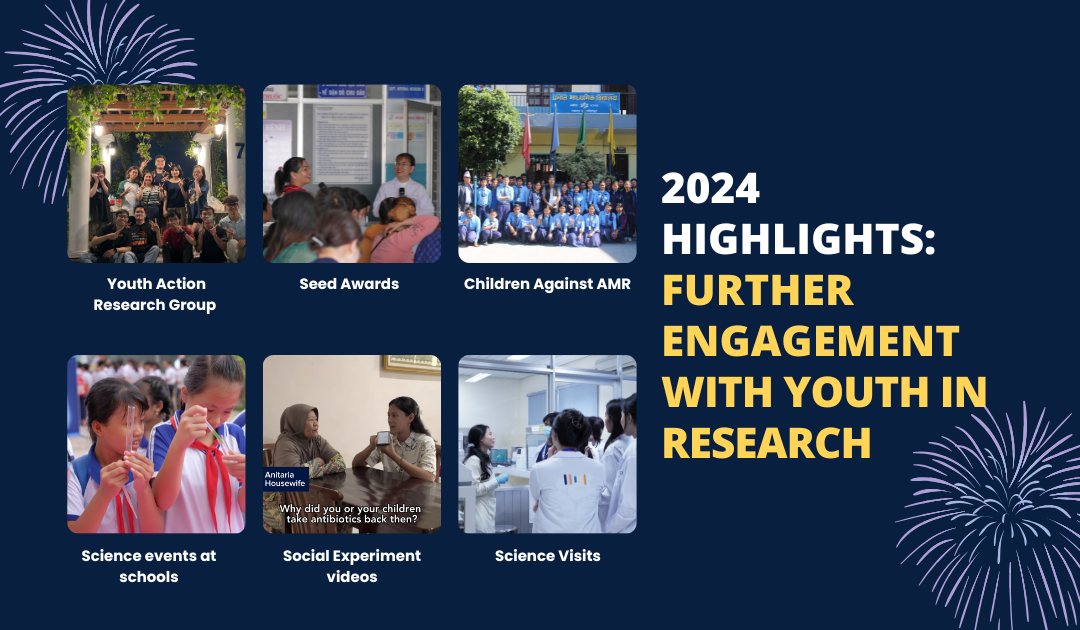
  • 2024 Highlights: Further Engagement with Youth in Research at OUCRU 

    2024 Highlights: Further Engagement with Youth in Research at OUCRU 

    As we reflect on 2024, let’s look at our public and community engagement achievements. One particular highlight is our continuing partnership with young people. Our commitment has been to nurture a strong connection between research and the younger generation through a range of activities across all sites. 

    Active Participation of Young People in Research 

    As part of SEACOVARIANTS—a multidisciplinary research project assessing the biological significance of SARS-CoV-2 variants to support evidence-based policymaking—the Youth Action Research Group in HCMC has been an integral part of efforts to listen to communities affected by health crises. 

    This initiative brings together passionate young people and empowers them through training and practical activities to actively participate in research and contribute their unique perspectives. The group is developing a outbreak preparedness engagement framework that will help identify hard-to-reach and heavily impacted groups during outbreaks. Their work will inform recommendations for improving public health policies during future health crises. 

    Opportunities for Young Scientists 

    Seed Awards project has been a focal point for promoting community engagement among young scientists at OUCRU for the last 9 years. By providing funding and support for community-driven research projects, we have encouraged young researchers to develop engagement solutions, inspired creativity and innovation as well as strengthened the bond between academia and the broader community.  

    Explore more engagement projects funded by Seed Awards here.  

    Nurturing Future Advocates 

    Children Against AMR in Nepal

    OUCRU Nepal has been celebrating World Antimicrobial Resistance (AMR) Awareness Week (WAAW) since 2016. As part of our mission to inform, interact with, and engage the community on AMR issues, our public engagement (PE) team conducted various activities for WAAW 2024. Following this year’s theme “Educate, Advocate, Act now,” we launched a comprehensive youth engagement campaign featuring innovative, creative, and participatory activities across digital and in-person platforms. Through visual storytelling and discussions, our team worked to raise awareness about AMR, promote responsible antibiotic use, and foster cross-sector collaboration. Here are the key highlights of our campaign: 

    • More than 120 students from three schools participated in the “Fighting AMR with Youths” educational sessions. 
    • 21 creative vlogs were produced exploring healthcare-seeking behaviors. 
    • “Paint down the bugs,” a two-day comic workshop, brought together 8 young artists who created four impactful stories to communicate complex AMR concepts. 
    • 46 young professionals from IT, pharmacy, engineering, medicine, and management attended our collaborative webinar “The AMR Chronicles: Battling the Invisible Enemy.” 
    Watch full playlist here.

    Raising Awareness among Young People in Indonesia 

    In Indonesia, many people use antibiotics as a general medication whenever they’re sick. With OUCRU’s support, CIMSA (Center for Indonesian Medical Students’ Activities) created a series of 3-minute social experiment videos. The student project team interviewed young people and the general public about their antibiotic use and knowledge. The findings were concerning but unsurprising: 8 out of 10 people were unfamiliar with AMR, and half reported using antibiotics for simple infections without proper diagnosis. The CIMSA and OUCRU team incorporated expert commentary from Dr. Robert Sinto to provide scientific context for further explanations and advices. 

    During this World AMR Awareness Week 2024’s initiative, CIMSA students gained valuable experience conducting research interviews and creating educational videos. This activity aligned with our mission to enhance scientific literacy and build capacity among young people and future generations. 

    Watch full playlist here.

    Making Science Making Sense: Science Theatre and Fair  

    OUCRU’s Public and Community Engagement Group launched a science theatre tour in Ho Chi Minh City middle schools to raise AMR awareness. The interactive play “Take Medicine Recklessly, Bacteria Can Resist” used humour and Gen Z-friendly elements to teach students about proper antibiotic use, successfully reached and engaged with 5,000 students. 

    Building on the AMR play’s success, OUCRU’s Public and Community Engagement group partnered with the Tien Giang Department of Education to organise science events, including community plays and a science fair. These events gave students a platform to demonstrate their scientific understanding and show how art can make complex topics accessible. 

    Beyond celebrating the achievements of Tien Giang’s students and teachers, these events aim to inspire other schools to embrace science education and encouraged young children to think critically about future health issues. 

    Applying Forum Theatre method to raise awareness on Tetanus, led and executed by Youth Science Ambassadors 

    Launched in 2024, the Youth Science Ambassadors (YSA) is an empowerment program for youth from 18 to 25 years old who enroll in universities in Ho Chi Minh City. The young people will join OUCRU as volunteered part-time collaborators for 1 year to participate in training and mentoring sessions on public engagement while planning and executing their own youth initiative. 

    From a quick survey on the needs to learn more about top 10 infectious diseases among young people, tetanus is second to last, which is alarming as several young people in Vietnam are not vaccinated. 

    Recognising the situation needs more public awareness on the danger of tetanus and encouraging everyone to vaccinate, YSAs 2024 decided to create Protect Us from Tetanus (PUFT) project featuring Hospital Health Talks for patients and carers and Forum Theater Performances for young people and the wider public. 

    Forum theatre, an interactive method that provides a platform for the audience to intervene and change the scenerio, thereby changing the consequences of stories that end on negative note, had been chosen with the aim that this engaging approach will help to encourage more young people to actively participate in the activity. In-person with a completely non-scripted play about the journey of getting tetanus infection has been touring through 4 schools in Ho Chi Minh City. The community-led scenarios will be digitalised for people who can’t join the on-site sessions. 

    Science Visits 

    Since 2017, Science Visits has played as a bridge connecting curious children with scientific research through engaging experiences. During these visits, young participants take guided tours of state-of-the-art labs, interact directly with scientists, observe researchers at work, and participate in interactive role-playing activities. After a short pause during the COVID-19 pandemic, Science Visits have now returned—expanding beyond school students to include university students, particularly those studying sciences. In 2024, we organised 6 tours, welcoming more than 120 participants, including both students and teachers with positive feedback. 

    2025 will be the year that we will continue to strengthen the connection between OUCRU’s research and local communities, nurturing future generations, and improving public understanding and awareness on global health issues. We look forwards to contributing to building an evidence-based, scientific-driven society while enhancing the quality of life through research.  

  • 56.8% of Young People Lost Concentration or Interest in Living in 2021 (*)

    56.8% of Young People Lost Concentration or Interest in Living in 2021 (*)

    Global and National Mental Health Statistics Among Youth 

    According to UNICEF, at least 30% of school-age children experienced stress, anxiety, or depression due to health-related social restrictions during and after the pandemic. Poverty, violence, gender social norms, high-pressure learning environments, and stressful life events all contribute to emotional and psychological distress among young people.(1) 
     
    Another UNICEF report from 2021 also revealed that more than 1 in 7 adolescents aged 10–19 globally has been diagnosed with a mental disorder.(2) 
     
    In Vietnam, 14.9% of the population (about 15 million people) suffer from mental disorders, with depression and anxiety accounting for 5.4%. Similar with UNICEF’s report, in 2020 during COVID-19, depression increased by 28% and anxiety by 26%.(3) 
     
    A research study of over 37,000 students at Vietnam National University of Ho Chi Minh City (VNU-HCMC) revealed widespread mental health challenges during the COVID-19 crisis. The study found that 56.8% of students lacked concentration or interest in studying and living, while 56.2% experienced sleep disorders. Students also commonly reported feelings of inadequacy, low self-esteem, and uncertainty about their life purpose. 
     
    The study reinforced previous findings on gender differences in mental health, showing that female students tend to have more sensitive stress responses to emergencies, leading to an increased risk of experiencing pressure and stress. 

    A comprehensive mental health support is urgently neccessary  

    These numbers highlight the urgent need for a systematic approach to young people’s mental health and the importance of developing support systems at home, in schools, and throughout society. 
     
    Participants of this study reported to have the limited use of systematic support methods. Most of them relied on self-entertainment, exercise, and staying connected with family and friends to maintain positive mental health. 
     
    The research highlighted how the lack of institutional support can amplify students’ mental health issues, particularly among third-year students who face mounting pressure about future employment while preparing for their thesis. The study recommends that public health centers and universities should provide psychosocial support and mental health services, especially for students at high risk of anxiety and depression. Targeted counseling services for career planning, stress management, and networking are among recommendations. 

    How Did Collab Lab Transform This Research into an Engaging Animation? 

    Collab Lab‘s mission is to make health science research more accessible and relatable to young people, and university students are their main target audience and stakeholders. Mental health is also one of Collab Lab’s key focus areas. Therefore, transforming this research becomes Collab Lab’s priority and is a challenge that Collab Lab was eager to conquer.  
     
    To make this research more accessible while highlight key academic findings, Collab Lab adopted the popular social media format of livestreaming— the current beloved entertaining platform by young people. 
     
    As a reporter, Collab Lab’s “ambassador” (key character) I-sà becomes a streamer reporting on a new “human” who embodies the mental health challenges young people faced during COVID. This creative approach allows viewers to recognise signs of mental health issues and find those related to them while being entertained. 
     
    We hope you will enjoy this video. Stay tuned and visit the Collab Lab page to watch the latest episode and all previous ones. 
     
    Don’t forget to leave us feedback and share our videos! 

    References:  

    1. https://www.unicef.org/vietnam/vi/suc-khoe-tam-than 
    1. https://moet.gov.vn/giaoducquocdan/giao-duc-the-chat/Pages/Default.aspx?ItemID=8616 
    1. https://dongnaicdc.vn/ty-le-nguoi-can-cham-soc-suc-khoe-tam-than-dang-tang-nhanh-va-tre-hoa 

    (*) Duong, C.B., Van Tran, N., Nguyen, A.H. et al. Impacts of COVID-19 crisis and some related factors on the mental health of 37150 Vietnamese students: a cross-sectional online study. BMC Public Health 23, 445 (2023). https://doi.org/10.1186/s12889-023-15317-3