तपाई यो समाचार  बहासा इनà¥à¤¡à¥‹à¤¨à¥‡à¤¸à¤¿à¤¯à¤¾Â र  नेपाली मा पनि पढà¥à¤¨Â सकà¥à¤¨à¥Â हà¥à¤¨à¥à¤›
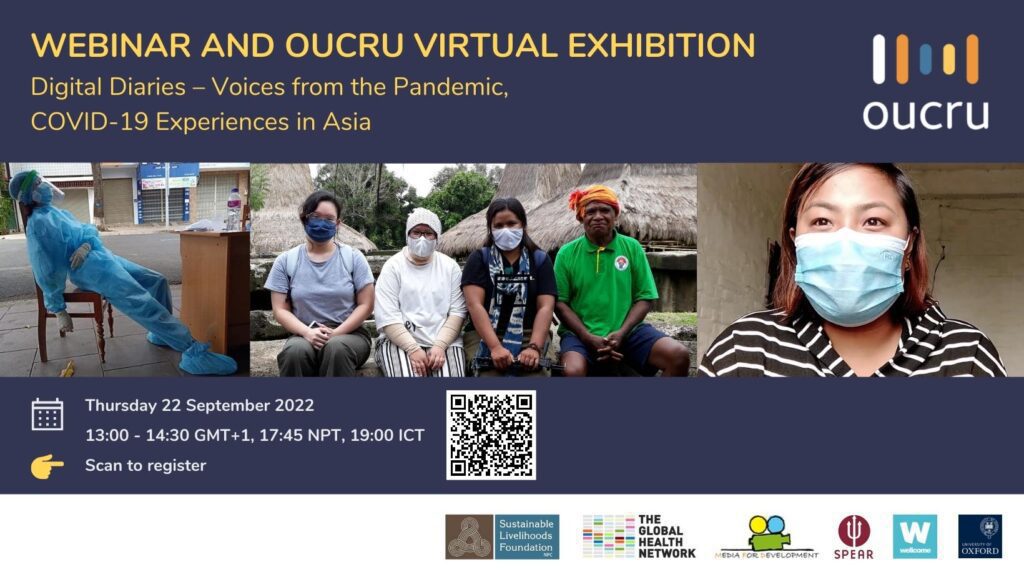
This online exhibition showcases short films and photographs created by healthcare workers and community members and documents the socio-cultural impact of the COVID-19 pandemic in Indonesia, Nepal, and Vietnam.
Please join us at a webinar to launch the exhibition: 22 September 2022 | 13:00 – 14:30 GMT+1Â (19:00 ICT, 17:45 NPT)
the practicalities and challenges of engaging with communities during periods of lockdown
‘digital diaries’ as a method for empowering individuals to express themselves
integrating this method into social science research studies.
Speakers:
Prof. Guy Thwaites, Director, Oxford University Clinical Research Unit and Wellcome Trust Major Overseas Programme in Vietnam; Professor of Infectious Diseases, University of Oxford.
This online exhibition showcases short films and photographs created by healthcare workers and community members and documents the socio-cultural impact of the COVID-19 pandemic in Indonesia, Nepal, and Vietnam.
Please join us at a webinar to launch the exhibition: 22 September 2022 | 13:00 – 14:30 GMT+1 (19:00 ICT, 17:45 NPT)
the practicalities and challenges of engaging with communities during periods of lockdown
‘digital diaries’ as a method for empowering individuals to express themselves
integrating this method into social science research studies.
Speakers:
Prof. Guy Thwaites, Director, Oxford University Clinical Research Unit and Wellcome Trust Major Overseas Programme in Vietnam; Professor of Infectious Diseases, University of Oxford.
According to the World Health Organisation, 10 – 15 per cent of Vietnam’s population is estimated to have viral hepatitis, including 1,07 million people who have Hepatitis C. Over 90 per cent of those who have Hepatitis C are not aware of their positive status.
OUCRU, the Hospital for Tropical Diseases (Ho Chi Minh City), and Vietnam’s National Hospital for Tropical Diseases (Hanoi) have been collaborating on Hepatitis C clinical trials since 2018. Our research is centred around predictive factors for selecting persons who could be successfully treated with shorter durations of antiviral therapy for Hepatitis C.
Currently, directly acting antiviral (DAA) therapy for Hepatitis C (HCV) offers high cure rates to those able to adhere to standard durations of treatment. In low- and middle-income countries like Vietnam, where treatment is limited to second-generation NS5A/NS5B-inhibitor combinations, the standard treatment is at least 12 weeks. This duration presents a barrier to successful engagement in care for some populations, hampering the elimination of HCV as a public health threat. Novel treatment strategies are required for hard-to-reach individuals, such as people who inject drugs and those with no fixed abode.
In addition, in Vietnam, DAA therapy for Hepatitis C remains prohibitively expensive for many of those infected. A standard twelve-week course of sofosbuvir and daclatasvir (SOF/DCV) was priced at US$2,417 – $2,472 in Ho Chi Minh City in 2019. Despite the government subsidising 50% of drug costs since, the Ministry of Health estimates only 1,000 individuals accessed DAA treatment through health insurance in 2019 and 2,700 in 2020.
The World Health Organisation has called for research into predictive factors for selecting persons who could be successfully treated with shorter durations of therapy, which could expand access to treatment and reduce drug costs.
We completed a small pilot study in 2020, looking at the early virological response as a means of guiding the duration of therapy of SOF/DCV, which remains the lowest-priced and most widely available treatment option globally.
We are also running an ongoing larger multi-arm randomised controlled trial exploring three different treatment shortening strategies for Hep C with two different drug combinations. We expect to complete recruitment in early 2023.
In addition, our team of OUCRU researchers recently performed a systematic review and meta-analysis of the seroprevalence of Hepatitis B, C and D in Vietnam from 1990-2020, which was published in The Lancet Western Pacific in May 2022. We found that while blood safety has improved, a renewed focus on HBV vaccination at birth and targeted HCV screening and treatment of people who inject drugs are urgently required to meet elimination targets.
To date, these clinical trials have recruited from populations already engaged in care at the HTD. Participants are aware of HCV infection and its implications and are well-motivated to seek treatment. Since our clinical trials are investigating the efficacy of treatment strategies that could be used to treat underserved populations (e.g. ultrashort or intermittent therapy), should these strategies have efficacy as hoped, it is crucial to develop innovative ways to engage with these ‘hard-to-reach’ populations, such as people who inject drugs (PWID), men who have sex with men, commercial sex workers, as well as low-income communities.
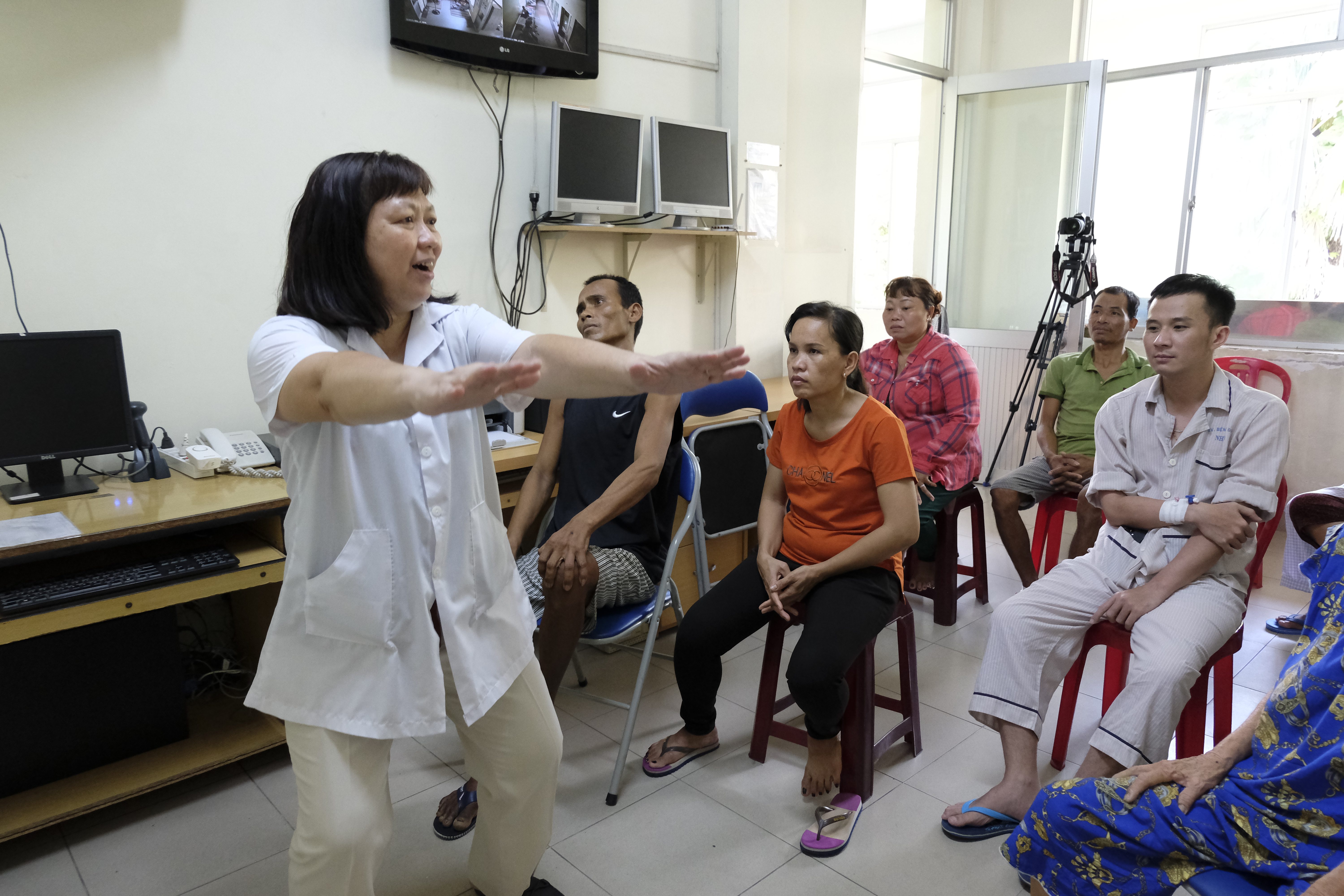
OUCRU’s social science and public engagement teams are currently working with these underrepresented groups, using community-based participatory research (CBPR) to engage with communities to create community-led strategies to improve linkages to care and treatment for populations at risk for viral hepatitis.
CBPR groups practising Venn Diagram as part of CBPR activities to identify stakeholders having impacts on underserved communities at risk of Hep C.
These studies are currently ongoing, with a positive impact on the participants. We hope to have a more significant impact on the treatment strategy and access to care for patients with Hepatitis C in Vietnam and worldwide in the future.
OUCRU’s Director, Professor Guy Thwaites, has recently contributed to an analysis of antibacterial agents in preclinical and clinical development by the World Health Organisation (WHO), as part of the WHO advisory group on research and development of antibacterial treatments.
The advisory group met virtually on 29 and 30 November 2021 to discuss and evaluate pipelines of antibacterial candidates in different stages of development around the globe. The resulting report – titled “2021 Antibacterial agents in clinical development and preclinical: an overview and analysis†– covers 77 antibacterial agents in clinical development, 45 of which are traditional (direct-acting small molecules) agents and 32 are non-traditional agents.
The report shows that the development of new antibacterial treatments is insufficient to tackle the increasing threat of antibiotic resistance. The number of new antibiotics in the preclinical stage has remained relatively constant over the last 3 years. However, in the clinical stage, there were only 27 new products against priority pathogens in 2021, compared to 31 products in 2017. Amongst those, only 6 fulfill at least one of WHO’s criteria for innovation. This is due to barriers such as the lengthy approval pathway, high cost, low success rates, and impact of the COVID-19 pandemic.
The 2021 analysis suggests that the issue demands urgent and concerted efforts from both governments and the private sector. They need to work together to accelerate the innovation of antibiotics, especially those that can make an impact in low-resource settings where antimicrobial resistance is most visible. There should also be collaboration across countries to create sustainable solutions, enhance research and development, as well as establish a viable ecosystem for antibiotics.
This observational study was designed to identify severe dengue patients by using a series of inflammatory markers. The authors generated an immunological signature that included ten markers for predicting the risk of severe dengue patients. The finding was significant to the development of biomarker panels for clinical use and could improve triage and risk prediction in dengue patients. The peer-reviewed article was published on eLife in June 2021.
First author Dr Nguyen Lam Vuong, a current PhD student at OUCRU and Open University (UK), shared: “This paper is a part of my PhD project, on which I’ve worked very hard. I am so proud that the international medical research community has recognised my efforts. This honour encourages me to continue my research career in medicine, and I hope to use this opportunity to build collaborations with other researchers and professors in the field.”
The Alexandre Yersin Prize for Outstanding Publications was created by the Swiss-Vietnamese Medical Association (HELVIETMED) to recognize Vietnamese scientists who have made important contributions to the medical literature, and through peer-reviewed publications, they help build Vietnam’s reputation in international medical research community. The Prize also aims to foster national and international collaborations for medical education and better health care.
TrÃch dẫn: N Van Hao PhD, H Thi Loan MD et al. Human versus equine intramuscular antitoxin, with or without human intrathecal antitoxin, for the treatment of adults with tetanus: a 2 × 2 factorial randomised controlled trial. The Lancet Global Health 2022;10(6):e862-e872. Available from: https://www.thelancet.com/journals/langlo/article/PIIS2214-109X(22)00117-6/fulltext