Blog

  • Genetics sheds light on the spread of tuberculosis bacteria

    A first of its kind study into the population and spread of tuberculosis-causing (TB) bacteria in Ho Chi Minh City, Vietnam, has found that more than half of cases can be attributed to one particular strain of the bacteria.

    Using state-of-the-art genomics technology, a Melbourne-led international collaboration, including researchers from OUCRU in Vietnam and Singapore, sequenced the DNA from bacteria isolated from the lungs of 1635 TB patients located in outpatient clinics in eight districts of Ho Chi Minh City. The findings, published in Nature Genetics this week, concluded that the strain of TB-causing bacteria known as the Beijing lineage, was responsible for 59 per cent of infections, and even more (75%) of those diagnosed in younger people.

    TB is the leading cause of death globally from a single infectious agent – Mycobacterium tuberculosis – that typically affects the lungs, but can also infect other sites of the body. Multiple antibiotics are used to treat TB, however treatment is long (six months), and the emergence of drug-resistant bacteria is a considerable threat to global health.

    Vietnam is one of the WHO High Burden Countries for TB and multi drug-resistant TB, and in 2016 there were an estimated 126,000 cases and 13,850 deaths in the South East Asian country. Co-lead Investigator of the study and a Senior Research Fellow, Dr Sarah Dunstan from the Peter Doherty Institute for Infection and Immunity (a joint venture of The University of Melbourne and The Royal Melbourne Hospital), said within the Beijing lineage they found a mutation, which likely bolsters the bacteria’s ability to spread. “Combating and managing TB spread requires new strategies to diagnose, treat and protect against emerging and evolving strains of the bacteria,” said Dr Dunstan. “Armed with an understanding of how the disease is spread in Ho Chi Minh City could allow more targeted local TB control, and this knowledge could potentially be applied to other settings given the Beijing lineage is found worldwide, predominantly in Asia.”

    First author on the paper describing the study, Associate Professor Kathryn Holt from the University of Melbourne’s Bio21 Molecular Science and Biotechnology Institute, said the study shows the Beijing lineage of TB bacteria spreads more easily from person-to-person than other strains of the bacteria. “Contact tracing – looking for early signs of TB infection in people who have been in close contact with TB patients, and treating them before they can spread the disease further – is an important part of TB control, but it takes a lot of resources,” said Associate Professor Holt. “All TB patients have the potential to transmit the TB bacteria to others when they cough, but our data indicates this is more likely to result in new disease cases if the infection is caused by the Beijing lineage. So if resources are limited, it would make sense to prioritise contact tracing for Beijing lineage TB cases.”

    Co-author Dr Nguyen T. T. Thuong, head of OUCRU’s TB group in Ho Chi Minh City, comments: “TB treatment fails in many patients infected with multidrug resistant strains, which are then passed on, increasing the number of resistant cases in the community. My team in Vietnam now is running a pilot study in early diagnosis of drug resistant TB cases using whole genome sequencing. The findings from this publication can be applied concurrently to identify those carrying the easily-spread-mutation. If this test becomes a bedside diagnostic tool, it will allow not only early diagnosis of drug resistance and more precise treatment but also better management against disease transmission.”

    The study was funded by the National Health and Medical Research Council in Australia, Wellcome Trust UK and A*STAR Biomedical Research Council Singapore.
  • [:en]OUCRU Open Day 18 May, 2018

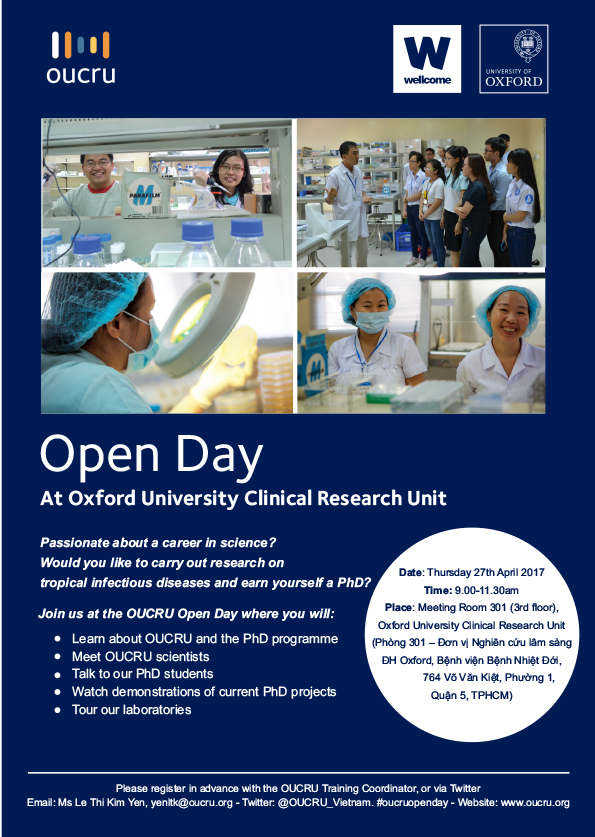
    OUCRU Open Day

    27th Apr 2017

    Passionate about a career in science? 

    Would you like to carry out research on tropical infectious diseases and earn yourself a PhD?

    Join us at the OUCRU Open Day where you will:

    • Learn about OUCRU and the PhD programme
    • Meet OUCRU scientists
    • Talk to our PhD students
    • Watch demonstrations of current PhD projects
    • Tour our laboratories

    open-day-2017
    Date: Thursday 27th Apr 2017

    Time: 9:00 – 11:30 am.

    At: the meeting room 301 (third floor)

    OUCRU

    Hospital for Tropical Diseases

    764 Vo Van Kiet, Ward 1, District 5, HCMC

    Please register in advance with the OUCRU Training Coordinator, or tweet us! 

    Twitter: @OUCRU_Vietnam. #oucruopenday

    Email: Ms Le Thi Kim Yen, email  yenltk@oucru.org

  • OUCRU Open Day 18 May, 2018

    OUCRU Open Day

    18th May 2018

    Passionate about a career in science? 

    Would you like to carry out research on tropical infectious diseases and earn yourself a PhD?

    Join us at the OUCRU Open Day where you will:

    • Learn about OUCRU and the PhD programme
    • Meet OUCRU scientists
    • Talk to our PhD students
    • Watch demonstrations of current PhD projects
    • Tour our laboratories

    open-day-2018
    Date: Friday 18th May 2018

    Time: 9:00 – 11:30 am.

    At: the meeting room 301 (third floor)

    OUCRU

    Hospital for Tropical Diseases

    764 Vo Van Kiet, Ward 1, District 5, HCMC

    Please register in advance with the OUCRU Training Coordinator, or tweet us! 

    Twitter: @OUCRU_Vietnam. #oucruopenday

    Email: Ms Le Thi Kim Yen, email  yenltk@oucru.org

  • Phổ biến kiến thức về bệnh sốt rét


    Loạt ảnh “Sốt Rét ở Châu Á” của nhiếp ảnh gia Pearl Gan đã được nêu bật trong số mới nhất của tạp chí Dia:gram Magazine. Và bà Pearl đã làm việc với giám đốc EOCRU, giáo sư Kevin Baird tại Indonesia về dự án này, trong nỗ lực ghi lại hình ảnh và những câu chuyện của những con người thật đang sống cùng căn bệnh sốt rét ở khu vực này và để thu hút sự quan tâm đến nhu cầu đầu tư trong việc kiểm soát và loại bỏ sốt rét ở Đông Nam Á nhiều hơn. Loạt ảnh này khám phá hành trình của những người bị ảnh hưởng bởi bệnh sốt rét, từ bệnh nhân, đến người thân gần nhất của họ và những nhân viên chăm sóc sức khỏe cộng đồng. Bà Pearl cho biết: “Chúng tôi hy vọng bộ sưu tập ảnh này sẽ nâng cao nhận thức về gánh nặng của bệnh sốt rét mà những cư dân ở các cộng đồng hẻo lánh này phải gánh chịu. Quan trọng là giúp mọi người trên khắp thế giới hiểu rõ những cộng đồng hẻo lánh và nghèo khổ ở Châu Á – Thái Bình Dương và hiểu rằng việc “phổ biến kiến thức” này sẽ giúp đẩy mạnh các nỗ lực giảm nhẹ gánh nặng này.”

    Trong lần phỏng vấn với tạp chí Dia:gram, giáo sư Kevin Baird đã chỉ ra rằng bệnh sốt rét ở Đông Nam Á là một vấn đề khác so với bệnh sốt rét ở Châu Phi. Cư dân muỗi truyền bệnh sốt rét là loài muỗi khác với muỗi ở Châu Phi. Sốt rét ở Châu Á gây ra bởi nhóm ký sinh trùng sốt rét khác. Ở Châu Phi, hầu hết bệnh nhân sốt rét bị nhiễm ký sinh trùng Plasmodium falciparum (P. falciparum), trong khi P. falciparum cũng tồn tại ở Châu Á. Khoảng một nửa số ca sốt rét gây ra bởi một nhóm khác: Plasmodium vivax (P. vivax). Sốt rét Vivax truyền bệnh theo cách khác với sốt rét falciparum, và vì thế nó cũng ảnh hưởng khác nhau đến cộng đồng. Ở Châu Á, nhiều người không được tiếp cận dịch vụ chẩn đoán và điều trị phù hợp và điều này khiến cho bệnh sốt rét lan rộng hơn. Và quan trọng hơn hết, sốt rét Vivax khó điều trị: thuốc chính được sử dụng (primaquine) gây nguy hiểm cho 8% dân số ở Nam Á và Đông Nam Á, những người có bất thường di truyền mang tên là thiếu men G6PD.

    Bệnh sốt rét tiêu biểu cho gánh nặng to lớn và phức tạp ở Nam Á và Đông Nam Á nhưng khu vực này chỉ nhận được một phần nhỏ tiền tài trợ toàn cầu cho việc kiểm soát và loại bỏ bệnh sốt rét: trong 2.7 tỉ USD được đầu tư vào năm 2016 – chỉ có 7% dành cho các nỗ lực ở Nam Á và Đông Nam Á. Trong bài báo có trích dẫn câu nói của giáo sư Kevin: “Cộng đồng của chúng ta sẽ được lợi ích rất lớn khi có nhiều nỗ lực nhắm cụ thể vào vấn đề bệnh sốt rét đa dạng và đáng chú ý ở Châu Á. Chúng ta cần có các nghiên cứu và các công cụ tốt hơn để đưa chúng ta đến mục tiêu đó.”

    Find out more

    WHO World Malaria report 2017

    Pearl Gan honoured in Swiss malaria photo contest

    Malaria research at OUCRU

    Pearl Gan’s article in the Lancet: Picturing health: Making malaria visible in the Asia Pacific

  • Making malaria visible

    Photographer Pearl Gan’s photo-series “Malaria in Asia” has been highlighted in the latest issue of Dia:gram Magazine.  Pearl has been working  together with EOCRU Director Prof Kevin Baird in Indonesia on this project, in an effort to capture photographs and stories of real people living with malaria in this region, and to draw attention to the need for further investment in malaria control and elimination in South and Southeast Asia. The photo-series explores the journey of those affected by malaria, from the patients, to their immediate famiies and the community care providers.  Pearl says, “We hope that the collection of photographs will raise awareness of the malaria burden suffered by the inhabitants of these remote communities. It is important to help people across the world to see into these isolated and impoverished communities in Asia Pacific, and that this new “visibility” will help boost efforts to reduce the suffering.”

    In the interview with Dia:gram magazine, Prof Kevin Baird pointed out that malaria in Southeast Asia is a very different problem than malaria in Africa. The mosquito populations that transmit malaria are different species from African mosquitoes. Asian malaria is caused by a different strain of the malaria parasite; in Africa most malaria patients are infected with Plasmodium falciparum (P. falciparum), and while P. falciparum also exists in Asia, about half of the malaria cases are caused by a different strain: Plasmodium vivax (P. vivax). Vivax malaria is transmitted differently from falciparum malaria, and so it affects communities differently. In Asia many people do not have access to adequate diagnostic services and treatments, and this makes the problem of malaria more widespread. And on top of all this, Vivax malaria is difficult to treat: the main drug used (primaquine) is dangerous for the eight percent of people in South and Southeast Asia who have an inherited abnormality called G6PD deficiency.

    Malaria represents an enormous and complex burden in South and Southeast Asia, and yet this region only receives a small fraction of the global funding for malaria control and elimination: of $2.7 billion USD invested in 2016 – only 7% was pegged for efforts in South and Southeast Asia. As Kevin is quoted in the article saying, “Our communities would benefit enormously by more vigorous efforts aimed specifically at the singular and diverse Asian malaria problem.  We need research and better tools to get us there.”

    Find out more

    WHO World Malaria report 2017

    Pearl Gan honoured in Swiss malaria photo contest

    Malaria research at OUCRU

    Pearl Gan’s article in the Lancet: Picturing health: Making malaria visible in the Asia Pacific


  • Phản ánh cuá»™c sống hằng ngày ở Hà Nam: Dá»± Án Nhiếp Ảnh Cá»™ng Đồng

    Chúng tôi sẽ tổ chức một buổi triễn lãm tranh tại Hà Nội vào ngày 23-24 tháng 3 và mời nhiều người đến tham dự

    Hội chứng não cấp (viêm não) là một vấn đề sức khoẻ nghiêm trọng ở Việt Nam với khoảng một nghìn trường hợp mỗi năm và để lại nhiều di chứng. Ở trẻ em, nguyên nhân thông thường nhất là do siêu vi khuẩn viêm não Nhật Bản. Bệnh nhân sẽ mắc bệnh nếu bị muỗi cắn, nhưng hiện đã có vắc xin phòng ngừa căn bệnh này. Tuy nhiên, có nhiều nguyên nhân khác của viêm não như vết cắn từ côn trùng, tiếp xúc với động vật và người bị bệnh. Hiện tại, có nhiều trường hợp chưa rõ nguyên nhân.

    Đơn vị Nghiên cứu Lâm sàng, Trường Đại học Oxford, Trường Đại học Liverpool, Vương quốc Anh cùng Viện Vệ sinh Dịch tễ Trung ương mong muốn thông qua hình ảnh về môi trường sống và các hoạt động sinh hoạt thường ngày có thể hiểu rõ hơn về cuộc sống của người dân. Chính vì lý do đó, tháng 1 năm 2018, đối tượng nghiên cứu tại 4 xã của tỉnh Hà Nam đã tham gia một hoạt động kết nối cộng đồng để chia sẻ thêm thông tin về các hoạt động hàng ngày của họ.

    Chúng tôi phát cho mỗi người dân một máy ảnh để ghi nhận các hoạt động thường ngày của họ. Một số người dân chụp ảnh và viết miêu tả về các bức ảnh họ đã chụp trong khi những người còn lại sử dụng những bức ảnh của họ để dựng thành một đoạn phim ngắn.

    Chúng tôi xin giới thiệu kết quả của hoạt động này. Hy vọng qua đây bạn sẽ có hiểu rõ hơn về cuộc sống hàng ngày của người dân Hà Nam.

    Location: 

    MANZI

    14 Phan Huy Ich, Ba Dinh, Hanoi

    March 23rd, 2018  18:00 – 21:00

    March 24th, 2018  09:00 – 17:00

  • Reflecting on daily life in Ha Nam: a public engagement photography project

    We will be hosting a photography exhibition in Hanoi on March 23rd and 24th and invite members of the public to come along.

    Acute encephalitis syndrome (brain inflammation) is an important health problem in Vietnam with around one-thousand cases per year and leaving many people with a disability. In children, the most common cause is Japanese encephalitis virus, from the bite of an infected mosquito. However, there is a vaccine available to prevent this. There are many other causes of encephalitis, such as bites from insects, contact with animals and close contact with infected people. Currently, we don’t know the cause in half of the people.

    Researchers from Oxford University Clinical Research Unit in Ha Noi and The University of Liverpool, UK in collaboration with the National Institute of Hygiene and Epidemiology, Ha Noi, wanted to visually understand people’s environment and daily activities. Thus, in January 2018, to further explore the link between acute encephalitis infection and risk behaviour, a public engagement activity was conducted in four communes in Ha Nam Province.

    The participants were given point and shoot cameras and asked to document their daily activities. They were broken up into two groups. The first group was asked to take photos and write accompanying text.  The second group was asked to take photos and then turn those photos into a short film with voice over narration.

    On display is a selection of photos and films as created by the participants. We hope this exhibit will give you the opportunity to glimpse into the daily life of the people in Ha Nam.

    Location: 

    MANZI

    14 Phan Huy Ich, Ba Dinh, Hanoi

    March 23rd, 2018  18:00 – 21:00

    March 24th, 2018  09:00 – 17:00


  • Aspirin for tuberculous meningitis treatment: yet another use for this remarkable drug?

    Tuberculous meningitis is the most lethal form of tuberculosis (TB), killing or disabling around half of all sufferers despite the best available treatment. Aspirin prevents blood clotting and helps reduce and resolve inflammation. We wondered whether this ancient drug might help increase survival from TB meningitis by reducing brain inflammation and preventing the disease from blocking blood vessels in the brain that cause parts of the brain to die (commonly called ‘stroke’).

    With funding from the Wellcome Trust, OUCRU researchers led by Prof Guy Thwaites investigated whether the addition of aspirin at low (81mg/day) or high (1000mg/day) dose, or placebo, to the first 60 days of current standard TB meningitis treatment (anti-TB drugs and steroids) was safe and reduced new strokes or death from this severe disease. The results of the trial have been published today in eLife.

    When we analysed all 120 patients who entered the trial we found that both aspirin doses were safe and both doses were associated with a reductions in new brain infarctions and death in the first 60 days of treatment, although these reductions could have occurred by chance. However, when we just looked at the 92 patients in our study that definitely had TB meningitis, with TB bacteria either seen or grown from brain fluid, there was a substantial reduction in stroke and death by 60 days. This was especially apparent in those given the high (1000mg) dose of aspirin:  34.4% of patients treated with placebo died or suffered stroke, whereas only 10.7% who received the high (1000mg) dose of aspirin suffered these complications. The benefit was still apparent for those who received the lower dose of aspirin – but less dramatic, with 14.8% suffering stroke or death.

    To understand how aspirin might work in TB meningitis treatment we took brain fluid from the trial participants before and after 60 days of treatment and measured an array of substances known to be linked to inflammation and aspirin’s treatment effects. When we compared 81mg with 1000mg of aspirin we found that 1000mg was associated with much lower concentrations of thromboxane A2, which would inhibit the blood’s ability to clot and may help prevent stroke. We also found higher concentrations of molecules called ‘protectins’ which help the body resolve inflammation. These findings are especially interesting as they may indicate new ways to treat TB meningitis and other forms of TB, and they support the trial’s clinical findings that aspirin 1000mg/day may reduce stroke and increase survival.

    Larger trials are now needed in children and adults, including those co-infected with HIV, to confirm our results. But it seems TB meningitis may be added to the long list of life-threatening conditions that benefit from a daily aspirin dose, including stroke, heart attacks, and the prevention of colorectal cancer.

    Dr Lindsay Keir, from Wellcome’s Clinical and Physiological Sciences team, said: “This study reminds us that better understanding of how diseases and existing drugs work can lead to innovative new treatments, without the large cost of developing a new drug. It offers hope to patients suffering from this deadly and disabling disease, although larger studies, looking at more patients in different locations, are needed to prove aspirins effectiveness before it could be recommended for routine treatment of TB meningitis.”

    A note on aspirin

    Aspirin is a commonly available over-the-counter medication. It is inexpensive, and an effective pain-reliever that can reduce fever and inflammation.  It has been shown to be effective in preventing and treating heart attacks and stroke, and more recently in may help prevent the development of colorectal cancer risk in men who have had previous heart attacks, and there is also evidence that it can be beneficial against stroke in women.  While aspirin was developed as a drug in the form we now recognise in the 19th century, the active compounds occur naturally in willow bark and other plants, and humans have been using it in its natural form for thousands of years. There is evidence of ancient Egyptians using willow bark as a medicine, and the ancient Greek physician Hippocrates wrote about the benefits of willow bark and willow leaves to relieve pain and fevers.  Nowadays, aspirin should be used in consultation with a doctor to minimize any side-effects, However, this study has shown more evidence that aspirin is indeed a remarkable drug.

  • Aspirin for tuberculous meningitis treatment: yet another use for this remarkable drug?

    Tuberculous meningitis is the most lethal form of tuberculosis (TB), killing or disabling around half of all sufferers despite the best available treatment. Aspirin prevents blood clotting and helps reduce and resolve inflammation. We wondered whether this ancient drug might help increase survival from TB meningitis by reducing brain inflammation and preventing the disease from blocking blood vessels in the brain that cause parts of the brain to die (commonly called ‘stroke’).

    With funding from the Wellcome Trust, OUCRU researchers led by Prof Guy Thwaites investigated whether the addition of aspirin at low (81mg/day) or high (1000mg/day) dose, or placebo, to the first 60 days of current standard TB meningitis treatment (anti-TB drugs and steroids) was safe and reduced new strokes or death from this severe disease. The results of the trial have been published today in eLife.

    When we analysed all 120 patients who entered the trial we found that both aspirin doses were safe and both doses were associated with a reductions in new brain infarctions and death in the first 60 days of treatment, although these reductions could have occurred by chance. However, when we just looked at the 92 patients in our study that definitely had TB meningitis, with TB bacteria either seen or grown from brain fluid, there was a substantial reduction in stroke and death by 60 days. This was especially apparent in those given the high (1000mg) dose of aspirin:  34.4% of patients treated with placebo died or suffered stroke, whereas only 10.7% who received the high (1000mg) dose of aspirin suffered these complications. The benefit was still apparent for those who received the lower dose of aspirin – but less dramatic, with 14.8% suffering stroke or death.

    To understand how aspirin might work in TB meningitis treatment we took brain fluid from the trial participants before and after 60 days of treatment and measured an array of substances known to be linked to inflammation and aspirin’s treatment effects. When we compared 81mg with 1000mg of aspirin we found that 1000mg was associated with much lower concentrations of thromboxane A2, which would inhibit the blood’s ability to clot and may help prevent stroke. We also found higher concentrations of molecules called ‘protectins’ which help the body resolve inflammation. These findings are especially interesting as they may indicate new ways to treat TB meningitis and other forms of TB, and they support the trial’s clinical findings that aspirin 1000mg/day may reduce stroke and increase survival.

    Larger trials are now needed in children and adults, including those co-infected with HIV, to confirm our results. But it seems TB meningitis may be added to the long list of life-threatening conditions that benefit from a daily aspirin dose, including stroke, heart attacks, and the prevention of colorectal cancer.

    Dr Lindsay Keir, from Wellcome’s Clinical and Physiological Sciences team, said: “This study reminds us that better understanding of how diseases and existing drugs work can lead to innovative new treatments, without the large cost of developing a new drug. It offers hope to patients suffering from this deadly and disabling disease, although larger studies, looking at more patients in different locations, are needed to prove aspirins effectiveness before it could be recommended for routine treatment of TB meningitis.”


    A note on aspirin

    Aspirin is a commonly available over-the-counter medication. It is inexpensive, and an effective pain-reliever that can reduce fever and inflammation.  It has been shown to be effective in preventing and treating heart attacks and stroke, and more recently in may help prevent the development of colorectal cancer risk in men who have had previous heart attacks, and there is also evidence that it can be beneficial against stroke in women.  While aspirin was developed as a drug in the form we now recognise in the 19th century, the active compounds occur naturally in willow bark and other plants, and humans have been using it in its natural form for thousands of years. There is evidence of ancient Egyptians using willow bark as a medicine, and the ancient Greek physician Hippocrates wrote about the benefits of willow bark and willow leaves to relieve pain and fevers.  Nowadays, aspirin should be used in consultation with a doctor to minimize any side-effects, However, this study has shown more evidence that aspirin is indeed a remarkable drug.

  • Tìm thấy vi khuẩn Salmonella và tồn dư kháng sinh trong thịt mua ở Việt Nam

    Trên 2/3 các mẫu thịt từ TP. HCM được kiểm tra chứa vi khuẩn Salmonella, theo một nghiên cứu mới của Đơn Vị Nghiên Cứu Lâm Sàng Đại Học Oxford (OUCRU).

    Các nhà nghiên cứu đã mua 117 mẫu thịt gà, bò và heo từ các điểm siêu thị và chợ truyền thống trong thành phố từ tháng 10/2016 đến tháng 3/2017. Kết quả phân tích cho thấy 80 mẫu (68.4%) bị nhiễm vi khuẩn Salmonella loại không gây bệnh thương hàn.

    “Kết quả này không khác lắm so với các nghiên cứu đã đăng trên các tạp chí khoa học quốc tế về Việt Nam” – theo bà Nguyễn Thị Nhung, nhà vi sinh học tại OUCRU và tác giả chính của đề tài. “Nhưng so với Châu Âu thì cực kỳ cao” – bà nói thêm.

    Bà Nhung dẫn số liệu giám sát từ Liên Minh Châu Âu năm 2014, chỉ ra tỷ lệ các mẫu thịt (mỗi mẫu 25g) nhiễm Salmonella là 2,26%, 0,62% và 0,23% đối với gà, heo và bò. Tỷ lệ tương ứng trong đề tài nói trên của OUCRU, với mẫu thịt lấy từ TP. HCM, là 71,8% (gà), 70,7% (heo) và 62,2% (bò).

    Thịt nhiễm vi khuẩn Salmonella, nếu không nấu chín kỹ, có thể khiến người ăn bị viêm dạ dày ruột. Người nhiễm Salmonella – loại không gây thương hàn – hầu hết đều tự khỏi, nhưng một số trường hợp trở thành bệnh nặng, tùy vào lượng Salmonella mắc phải.

    “Đáng lo ngại là số lượng lớn Salmonella trong một vài loại thịt, nhất là thịt gà mua ở chợ truyền thống. Loại thịt này chẳng những chứa Salmonella, mà còn là một lượng lớn vi khuẩn” – bà Nhung nhận định. Bà ước tính có 1.500 khuẩn Salmonella trong mỗi gam thịt gà ở chợ truyền thống, đồng thời lưu ý cần có thêm nghiên cứu để giải thích độ nhiễm khuẩn cao như vậy.

    OUCRU đã kiểm tra tính kháng kháng sinh (lờn thuốc kháng sinh) của các chủng vi khuẩn Salmonella phân lập được từ thịt. Các nhà nghiên cứu nuôi các chủng Salmonella trong phòng thí nghiệm, rồi kiểm tra độ nhạy của chúng với 32 thuốc kháng sinh. Có đến 52,2% các chủng Salmonella đa kháng thuốc, nghĩa là kháng với ít nhát ba (03) nhóm kháng sinh. Chủng đa kháng thuốc Salmonella Kentucky ST198 là chủng được tìm thấy nhiều nhất trong nghiên cứu này, với tỷ lệ cao kháng với nhóm kháng sinh β-lactam và quinolone. Riêng một chủng từ thịt heo thể hiện tính kháng với colistin. Đây là lần đầu tiên vi khuẩn kháng với colistin được tìm thấy trên thịt ở Việt Nam (colistin là thuốc kháng sinh dùng để trị bệnh nhiễm khuẩn nặng, thường chỉ được sử dụng cho người như giải pháp cuối cùng, khi các thuốc khác không hiệu quả).

    Người có thể bị nhiễm vi khuẩn kháng kháng sinh khi tiếp xúc xử lý thịt hoặc ăn thịt, trứng, rau chưa chế biến kỹ. Để phòng tránh lây nhiễm, người chế biến nên rửa tay sạch và cẩn thận trong khâu chế biến thực phẩm, bao gồm việc rửa rau.

    OUCRU còn hợp tác với Viện Thú Y Quốc Gia và Chi Cục Chăn Nuôi-Thú Y Đồng Tháp để kiểm tra tồn dư kháng sinh trong thịt.

    Tồn dư kháng sinh trong thực phẩm có nguồn gốc động vật, như thịt, sữa và trứng, có thể ảnh hưởng xấu đến sức khỏe của người ăn, như gây dị ứng/ngộ độc, làm rối loạn hệ vi sinh đường ruột. Tồn dư kháng sinh còn có thể dẫn đến sự hình thành vi khuẩn kháng kháng sinh.

    Nhóm nghiên cứu đã phân tích tổng cộng 357 mẫu thịt gà, heo và bò mua từ chợ truyền thống và siêu thị ở TP. HCM, Hà Nội và Đồng Tháp.

    Kết quả cho thấy 7,3% các mẫu chứa tồn dư kháng sinh. Cụ thể tỷ lệ mẫu thịt có kháng sinh ở chợ truyền thống là 9,6%, cao hơn tỷ lệ ở siêu thị là 2,6%. Sự chênh lệch giữa hai kênh bán lẻ này có ý nghĩa thống kê (giá trị p là 0,016), chứng tỏ sự việc không phải ngẫu nhiên.

    Kết quả trên dường như thấp so với các nghiên cứu tồn dư kháng sinh trước đây tại Việt Nam. Nhưng tỷ lệ dù thế nào thì tồn dư kháng sinh trong thịt đều không chấp nhận được, vì nó thể hiện người chăn nuôi không tuân thủ thời gian ngưng sử dụng kháng sinh cho vật nuôi trước khi xuất chuồng.

    Kết quả chi tiết của các nghiên cứu viên OUCRU và cộng sự được đăng trong một bài báo khoa học thuộc Tạp Chí Quốc Tế Về Vi Sinh Thực Phẩm (tên gốc tiếng Anh: International Journal of Food Microbiology).

    Nghiên cứu này là đề tài mở rộng của ViParc, một thử nghiệm trên các trang trại và hộ chăn nuôi ở Đồng Tháp từ năm 2016-2020 nhằm giúp người dân Đồng Bằng Sông Cửu Long nuôi gà khỏe mạnh nhưng sử dụng ít thuốc kháng sinh hơn.