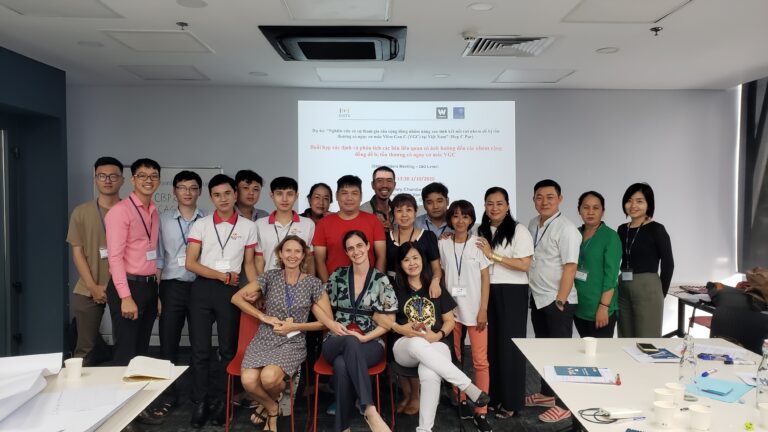



As part of the project to Improve Hepatitis C Access and Treatment for Underserved Communities, OUCRU’s Public and Community Engagement Group together with Social Science, Ethics, and Implementation Research Group organised a dialogue session between community members, social insurance representatives, and social scientists.
The session brought together representatives from underserved communities who had contributed to the project through community-based participatory research (CBPR), including people who inject drugs (PWID) , people with limited financial resources, and LGBT+ individuals. They shared their challenges in accessing health insurance for hepatitis C treatment and care.
Viet Nam has the fifth highest liver cancer incidence and death rate in the world and approximately 8 million people have hepatitis B, C or both(1). Even though Hepatitis C treatment is available in Vietnam, several barriers affect hepatitis C testing, diagnosis, and treatment. These barriers include that testing and diagnosis can only be performed at provincial and central hospitals, people may be asymptomatic or unaware they need testing, and test results often take a long time. High treatment costs before they are covered by insurance are also a big challenge.
In 2018, Vietnam changed the insurance regulations related to Hepatitis C treatment. Specifically, Hepatitis C patients can receive financial support from health insurance for testing costs, treatment costs using approved medications listed in the insurance catalog, and necessary medical procedures and treatments during treatment (which may be partially or fully covered). Typically, health insurance in Vietnam supports 30% – 50% of the costs for those defined medical services, depending on insurance registration conditions and insurance types(2).
Community members face both systematic and objective challenges.
The event opened an open discussion for community members to highlight several challenges they face despite recent improvements in social insurance policies.
Systematic challenges:
- Complex healthcare system. Vietnam’s multi-tiered hospital system has specific scopes and facilities at each level. For Hepatitis C, lower-tier hospitals may lack diagnostic and treatment capabilities, requiring patient transfers to higher tiers. Insurance coverage varies between tiers with different terms and paperwork, creating additional administrative complexity.
- Information gaps. Despite the government’s efforts in simplifying the registration and renewal process through the People’s Committees’ ward offices and post offices, many community members remain unaware of these options as well as their HepC treatment benefits under health insurance.
Objective challenges:
- Documentation barriers. One outstanding challenge for marginalised populations is insufficient personal documentation (such as government ID) needed to obtain health insurance. While the government has appointed some certain social enterprises as community representatives to help, it’s a long way to go.
- Financial constraints. Though social health insurance in Vietnam is designed to be affordable, it remains challenging for many, especially those without stable employment or those facing personal financial burdens such as debts or medical expenses for family members.
- Medical privacy concerns. The hospital referral process may require patients to disclose HIV status or other chronic conditions in order to access HepC treatment at higher-tier hospitals, compromising their right to privacy.
“We need to keep the conversation going.”
Acknowledging the power of listening to community voices, Associate Professor Jennifer Van Nuil, Head of Social Science, Ethics, and Implementation Research Group, emphasised the importance of how CBPR (community-based participatory research method) can help to set up strong support networks within and for the community.
“Social Healthcare Insurance is part of the Vietnamese government’s social security policy. We aim to reach 95% of Vietnam’s population.”
MsC. Nguyen Thi Thu Hang, Vice President of Ho Chi Minh’s Social Healthcare Insurance
Ms Hang also expressed appreciation for the community’s initiatives and their clear sharings of their situations as well as emphasised that community discussions like this could significantly help reach underserved populations.
References:
- https://www.who.int/vietnam/news/detail/28-07-2024-world-hepatitis-day—viet-nam-pilots-action-to-improve-access-to-hepatitis-c-care
- https://thuvienphapluat.vn/phap-luat/dieu-tri-benh-viem-gan-c-co-duoc-bao-hiem-y-te–chi-tra-chi-phi-thuoc-dieu-tri-khong-quy-dinh-cua-p-5814.html